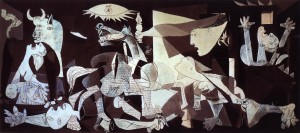
There are some breathtaking symmetries here.
As Ian Patterson notes in the LRB:
The world’s first aerial bombing mission took place 100 years ago, over Libya. It was an attack on Turkish positions in Tripoli. On 1 November 1911, Lieutenant Cavotti of the Italian Air Fleet dropped four two-kilogramme bombs, by hand, over the side of his aeroplane. In the days that followed, several more attacks took place on nearby Arab bases. Some of them, inaugurating a pattern all too familiar in the century since then, fell on a field hospital, at Ain Zara, provoking heated argument in the international press about the ethics of dropping bombs from the air, and what is now known as ‘collateral damage’. (In those days it was called ‘frightfulness’.) The Italians, however, were much cheered by the ‘wonderful moral effect’ of bombing, its capacity to demoralise and panic those on the receiving end.
A hundred years on, as missiles rain down on Gaddafi’s defences and sleeping Libyan soldiers are blasted and burned, we hear claims of a similar kind: the might of the western onslaught will dissipate all support for Gaddafi’s regime and usher in a new golden age for everyone. Just as Shock and Awe were meant to in Iraq. Or bombing and defoliation were meant to in in Vietnam. Or as the London Blitz was meant to break Britain’s spirit. Yet all the evidence suggests that dropping high explosive on places where people live increases their opposition, their solidarity and their resolve. Happy Anniversary.
The first time I came across Lt. Cavotti’s name was in “Icarus (Armed with Vipers) Over Iraq,” a terrific essay by Tom Englehardt, written way back in 2004. It was the first reference I had ever read to Sven Lindqvist’s brilliant A History of Bombing.
That essay, and that book, opened my eyes to the singular and pervasive evil that is bombing (and, alas, to America’s leading role in its deployment). Englehardt’s overview of the American century o’ bombing could use a little updating (the Predators hadn’t entered our consciousness in that distant naive year of 1994—when we thought getting rid of Bush would stop the carnage!)
Nevertheless, this is a pretty good summation of a century of death from above, or War American Style!
According to Sven Lindqvist’s (irritatingly organized but fascinating) labyrinth of a book, A History of Bombing, one Lieutenant Giulio Cavotti “leaned out of his delicate monoplane and dropped the bomb — a Danish Haasen hand grenade — on the North African oasis Tagiura, near Tripoli. Several moments later, he attacked the oasis Ain Zara. Four bombs in total, each weighing two kilos, were dropped during this first air attack.”
On the “natives” in the colonies, naturally enough. What better place to test a new weapon? And that first attack, as perhaps befits our temperaments, was, Lindqvist tells us, for revenge, a kind of collective punishment called down upon Arabs who had successfully resisted the advanced rationality (and occupying spirit) of the Italian army. Given where we’ve ended up, it would be perfectly reasonable to consider this moment the beginning of modern history, even of modernism itself.
A generation, no more, from Kitty Hawk to 1,000-bomber raids over Germany. Another from the atomic bombing of Hiroshima to “shock and awe” in Iraq. No more than a blink of history’s unseeing eye. Between 1911 and the end of the last bloody century, villages, towns and cities across the Earth were destroyed in copious numbers in part or in full by bombs. Their names could make up a modern chant: Chechaouen, Guernica, Shanghai, London, Coventry, Hamburg, Dresden, Tokyo, Hiroshima, Nagasaki, Damascus, Pyongyang, Haiphong, Grozny, Baghdad, and now Falluja among too many other places to name (and don’t even get me started on the bomb-ravaged colonial countryside of our planet from Kenya to Malaya). Millions and millions of tons of bombs dropped; millions and millions of dead, mostly, of course, civilians.
And from the Japanese and German cities of World War II to the devastated Korean peninsula of the early 1950s, from the ravaged southern Vietnamese countryside of the late 1960s to the “highway of death” on which much of a fleeing Iraqi army was destroyed in the first Gulf War of 1991, air power has been America’s signature way of war.
Think of it this way: Imagine the history of the development of the plane and of bombing as, in shape, a giant, extremely top-heavy diamond. In 1903, one fragile plane flies 120 feet. In 1911, another only slightly less fragile plane, still seeming to defy some primordial law, drops a bomb. In 1945, vast air armadas take off to devastate chosen German and Japanese cities. On August 6, 1945, all the power of those armadas are compacted into the belly of the Enola Gay, a lone B-29, which drops its single bomb on Hiroshima, destroying the city and so many of its inhabitants. And then just imagine that the man who commanded the U.S. Army Air Forces, both the armadas and the Enola Gay, General Henry “Hap” Arnold (according Robin Neillands in The Bomber War, The Allied Air Offensive Against Nazi Germany), “had been taught to fly by none other than Orville Wright, one of the two men credited with inventing the first viable airplane.” Barely more than a generation took us from those 120 feet at Kitty Hawk past thousand-plane bomber fleets to the Enola Gay and the destruction of one city from the air by one bomb. Imagine that.
Then imagine that both civilian plane flight and the killing of enormous numbers of civilians from the air (now subsumed in the term “collateral damage”) have over that not-quite-century become completely normal parts of our lives. Too normal, it seems, to spend a lot of time thinking about or even writing fiction about. When we get on a plane today, what do we do –close the window shade and watch a movie on a tiny TV screen or, on certain flights, TV itself in real time as if we were still in our living rooms. So much for either shock or awe. Today, American planes regularly bomb the distant cities of Iraq and no one even seems to notice. No one, not even reporters on the spot, bothers to comment. No one writes a significant word about it. Should we be amazed or horrified, proud or ashamed?