Month: February 2010

The useless farmer in winter

I know. Winter on a farm is much worse in Minnesota, my home state, where temperatures can stay below zero for weeks on end. But by Kentucky standards, this has been a hard winter. And for me, that’s plenty hard.  Sub-freezing temperatures and howling winds make taking care of farm beasts stressful–for the beasts, and (especially) for the farmer. I spend most of my time fretting about water, hay, wind, ice, and mud.

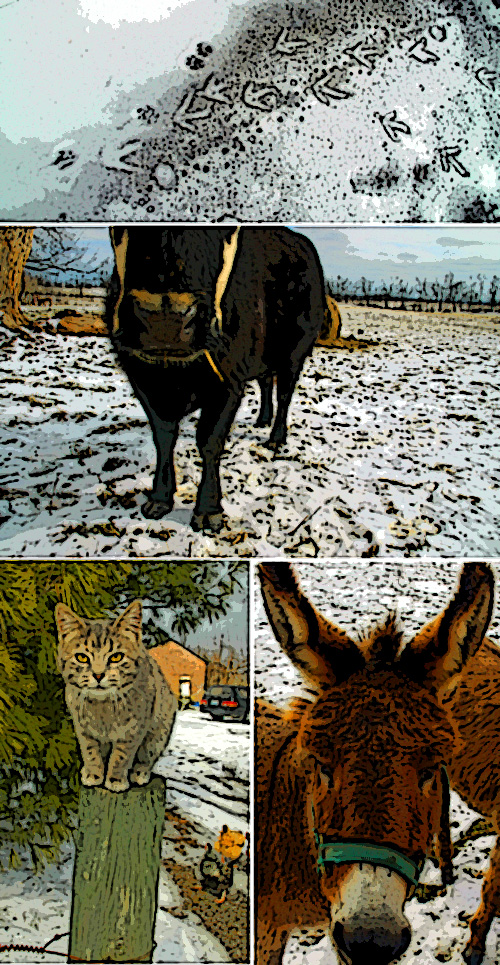
I’m against keeping cows in barns. I don’t have a totally sound basis for this stance, but I feel strongly about it, for some reason. My 13 cows are outside all winter. That wasn’t a problem last year, but last year was a milder winter, the ice storm notwithstanding.

The hay I’ve put out for my seven pregnant cows is of pretty poor quality. It comes from my neighbor, who loaned me a bull for breeding in August. It only took the bull a few weeks to finish his business, but he has been with us ever since, eating as much hay as three cows. My neighbor and I have a strange relationship.

Last week I weaned four calves off their mamas, and my timing couldn’t have been worse. The pen where I’ve put the calves is totally exposed to the wind, which gusted to 40-some mph and  brought the wind chill into negative numbers the night before last.

I have nice hay for the calves, in square bales. The mamas much prefer the square bales to the big round ones I’ve set out for them, to the point where they pretty much ignore their hay, and fight over every scrap of the calves’ hay that happens to blow out of the pen.

Generally speaking, it’s a good thing that I spend a lot of time among my cows. They are all extremely tame and calm because I’m familar to them. But I cannot lie: they are BOSSY BITCHES. It’s always crystal clear if they’re unhappy with a state of affairs. And they are unhappy.

My chickens, in contrast, are wonderful winter animals. They are laying lots of eggs and seem to have no problem roosting in a frigid hen house. I feed them well, but they can’t supplement what I give them with foraging in the ice and snow, so they too are always hungry, and follow me around in a pack whenever I am outside. They even swarm around me when I am up with the cows, and fearlessly peck around beneath the legs of the big beasts, who are not terribly bothered by their presence.

I have a pair of donkeys I’ve grown attached to, but have always been a little ambivalent about having, since they came as the result of an executive decision by my wife, who thought it would be nice to have them.  They are funny, skittish beasts, and the cows try to run them off at every opportunity. When it comes to defending the coffee can of sweet feed I give them every day,  they stand their ground quite nicely,  fending off the cows with sharp rearward kicks while they eat.

And then there’s the bees, who should be able to overwinter by themselves with no extra help from me. And yet the first cold snap killed one of my three hives. Weirdly, it was the one with the most honey in it. Why did they die? I really don’t know. Perhaps there weren’t enough bees to make a warm cluster. Perhaps they were weakened by disease or parasites. Dead bees tell no tales.  Or it might have  been the wind.

I determined that the bees also needed a wind break, but I could not find anything close at hand, so I parked my rusting 1988 Chevy Cheyenne  across the path of the wind. Which was a good idea, but with an unforeseen consequence. My spot in front of the hive is situated on a slight downslope, and is up against a fence.  The Cheyenne’s traction is negligible in the best of times, so as soon as I stopped I realized there was little hope of my backing out of that patch of icy snow, and the fence kept me from going forward. Unwilling to go without the truck til the ground thaws and then dries out (which could be as late as May), I had to snip a hole in a woven wire fence to drive the truck through.  It was just the latest in a series of clumsy desecrations of the farmstead to make up for a poorly thought out decision.

But so far everyone is surviving. All the animals are alive and on the property.  I am not a good farmer, but I’m better than I was.

Fancy: Gonna move you uptown

Bobbie Gentry’s “Fancy”, another entry in the creepiest country song ever sweepstakes.

If you know it, you probably know it from Reba’s over-the-top 1990 version. This one is over the top in its own way but the song just comes off way cooler, like something off Dusty in Memphis. (I had to look it up to check, but Dusty never covered this, which is a shame.) Love the set, the body suit, the de rigeur spidery eyes, and Bobbie’s little shuffle strut dance.

Margaret Flowers evokes memories of another Margaret

A terrific, informative Bill Moyers interview with Dr. Margaret Flowers of Mad as Hell Doctors and Physicians for a National Health Program.  Dr. Flowers presents her case for Medicare for All/Single Payer in a calm, resolute, persuasive manner.

Dr. Flowers and Dr. Carol Paris have spoken before Congress, and were arrested at the Senate Finance Committee Hearings on HCR for daring to speak up for single payer after the solution favored by most Americans was yanked off the table.

More recently, Drs. Flowers and Paris took Obama up on his “Let me know” spiel at the State of the Union address–and were again arrested for their troubles.  (“If anyone from either party has a better approach that will bring down premiums, bring down the deficit, cover the uninsured, strengthen medicare for seniors and stop insurance company abuses, let me know. Let me know. Let me know. I’m eager to see it.” Does ANYONE in America believe that?)

The tale Dr. Flowers tells is not a pretty one, and it may be surprising, if you still harbor the delusion that the Obama Administration is a force for positive change.

I loved the Moyers comment:

When I saw pictures of Margaret Flowers being led away, I remembered those famous words attributed to another Margaret, the anthropologist Margaret Mead who said, “Never doubt that a small group of thoughtful, committed citizens can change the world. Indeed, it is the only thing that ever has.”

Against all the evidence, I find Dr. Flowers’ resolve to be a reason for optimism. And I am grateful for Moyers, who has given her air time on his program (which, sadly, is in its last season on television).


more about “Bill Moyers Journal . Watch & Listen …“, posted with vodpod

“Blood harmony”

Absolutely killer performance of a Richard Thompson song by Del McCoury, along with sons Ronnie and Rob. If you stick around to the end (and you should), there’s a brief chat where Vince Gill talks about “blood harmony … nothing better in the world than hearing family sing together .”

Del looks like a complete gentleman but when he narrows those eyes, well, when he sings “I tell you in earnest I’m a dangerous man,” there is no suspension of disbelief needed on my part.

I also think highly of the line, “Red hair and black leather, my favorite color scheme.”

Current age compared (unfavorably) to Salem Witch Era

Glenn Greenwald’s The Lynch Mob Mentality observes that we have gotten to a very bad place, in fact a certifiable crazy-place, to use Dahlia Lithwick’s phrase, where the government’s claim that someone is a terrorist is reason enough for said person (along with anyone nearby) to be vaporized anywhere on the planet, even if that person is an American citizen.

Terrorists have no rights, and being accused is the same as being convicted.

Greenwald compares our current the irrational blood lust of our age to that of the Salem Witch Era, and finds it compares unfavorably to what had been the paradigm of superstitious arbitrary lawlessness.

[I]n fairness to the 17th Century Puritans, at least the Salem witches received pretenses of due process and even trials (albeit with coerced confessions and speculative hearsay).  Even when it comes to our fellow citizens, we don’t even bother with those.  For us, the mere accusation by our leaders is sufficient:  Kill that American Terrorist with a drone!

http://www.google.com/firefox?client=firefox-a&rls=org.mozilla:en-US:official

“Terrorism-derangement syndrome,” a phrase that should be forever enshrined in our cultural vocabulary…

… but won’t be.

Because we are all deranged. Duh.

Dahlia Lithwick , in yesteday’s typically despair-inducing and yet still somehow sparklingly witty essay in Slate, has really put her finger on one of the many bizzarro maladies afflicting the American psyche.

The real problem is that too many people tend to follow GOP cues about how hopelessly unsafe America is, and they’ve yet again convinced themselves that we are mere seconds away from an attack. Moreover, each time Republicans go to their terrorism crazy-place, they go just a little bit farther than they did the last time, so that things that made us feel safe last year make us feel vulnerable today.

“Terrorism crazy-place” is a pretty good turn of phrase too, I must say. Dang, she’s good.

Partisan Democrats might be tempted to play their favorite game and say, “See? It’s them!” but Dahlia is not pinning TDS all on the Republicans. “[W]hat was once tough on terror is now soft on terror. And each time the Republicans move their own crazy-place goal posts, the Obama administration moves right along with them.” Yes, the Repugs take the lead, but who’s making the party in control of everything follow along?

No, TSD afflicts both parties, and the general public as well. Definitely this piece must be read in full, but I hope I’ll be forgiven for quoting such a large chunk of it:

But it’s not just the establishment that opposes closing Guantanamo, trying Khalid Sheikh Mohammed, or reading Umar Farouk Abdulmutallab his Miranda rights. Polls show most Americans want Abdulmutallab tried by military commission, want Gitmo to remain open, and want KSM tried in a military commission, too. For those of us who are horrified by the latest Republican assault on basic legal principles, it’s time to reckon with the fact that the American people are terrified enough to go along.

We’re terrified when a terror attack happens, and we’re also terrified when it’s thwarted. We’re terrified when we give terrorists trials, and we’re terrified when we warehouse them at Guantanamo without trials. If a terrorist cooperates without being tortured we complain about how much more he would have cooperated if he hadn’t been read his rights. No matter how tough we’ve been on terror, we will never feel safe enough to ask for fewer safeguards.

Now I grant that it’s awfully hard to feel safe when the New York Times is publishing stories about a possible terrorist attack by July. So long as there are young men in the world willing to stick a bomb in their pants, we will never be perfectly safe. And what that means is that every time there’s an attack, or a near-attack, or a new Bin Laden tape, or a new episode of 24, we’ll always be willing to go one notch more beyond the rules than we were willing to go last time.

Some of the very worst excesses of the Bush years can be laid squarely at the doorstep of a fictional construct: The “ticking time bomb scenario.” Within minutes, any debate about terrorists and the law arrives at the question of what we’d be willing to do to a terrorist if we thought he had knowledge of an imminent terror plot that would kill hundreds of innocent citizens. The ticking time bomb metaphor is the reason we get bluster like this from Sen. Susan Collins, R-Maine, complaining that “5-6 weeks of ‘time-sensitive information’ was lost” because Abdulmutallab wasn’t interrogated against his will upon capture.

But here’s the paradox: It’s not a terrorist’s time bomb that’s ticking. It’s us. Since 9/11, we have become ever more willing to suspend basic protections and more contemptuous of American traditions and institutions. The failed Christmas bombing and its political aftermath have revealed that the terrorists have changed very little in the eight-plus years since the World Trade Center fell. What’s changing—what’s slowly ticking its way down to zero—is our own certainty that we can never be safe enough and our own confidence in the rule of law.

So now we’re straight

school lunch
yup, that's what they eat

We now know pretty much exactly the priorities of the Administration everyone was so excited about … a year ago, when it was all hope and CHANGE and promising all sorts of things for our nation’s kids.

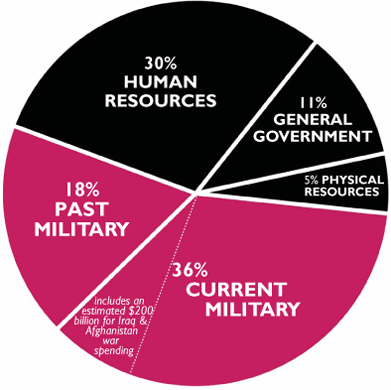
The Obama Adminstration’s budget for the coming year features the largest military budget in U.S. history,which of course also means the largest military budget in the planet’s history, and for that matter in the history of the known universe.

And for improving the school lunches of America’s hope and future?  The new budget sets aside … make Dr. Evil fingers here … one BILLION dollars for school lunches. Um. Er. To be shared with WIC. Which works out to an extra … 20 cents per meal! According to Jill Richardson of La Vida Locavore, The School Nutrition Association asked Congress for a whopping extra 35 cents per meal. What the kids get is not even enough for an extra apple per day!

Just so we’re clear. Obama is spending more on the military than anyone ever has! For our nation that just happens to be blessed with vast oceans east and west, not to mention friendly neighbors north and south. And for our kids? Not so much.

Even if you are not just being an ideological neo-dickensian with all this absurd talk about reducing the deficit without touching the military’s myriad entitlements, this still makes little sense. As Tom Philpott of grist.org notes:

Stiffing the school lunch program—enshrining it as the site where the food industry dumps cheap processed crap and shapes the tastes of kids—is the opposite of “fiscal responsibility.” It’s saddling millions of future adults with hefty medical bills they won’t be able to pay—and with lives diminished by chronic bad health.

pie chart
where the money really goes

Timeless: “Love vigilantes”

“Love vigilantes” came around on my ITunes while I was fixing dinner. A Laura Cantrell song I must have downloaded ages ago, but only tonight popped into the foreground. It was haunting, about a homesick soldier who finally gets his “leave” and flies home–to find his wife on the floor clutching a telegram that “said that I was a brave, brave men but that I was dead.” It was strangely familiar, but weirdly hard to pinpoint, as if from some distant era. World War I? The Korean War? Vietnam?

Actually you only have to go back to 1985. The band: New Order. I didn’t recognize this stripped-down version. I had heard it countless times before, but never, to my shame, paid much attention to the lyrics. At first I thought Persian Gulf War, but the years didn’t line up. The Falklands seems the most likely, though it could be any war.

It took Laura Cantrell (much beloved of John Peel, who of course also loved New Order) to find the beautiful, sad, ghostly ballad inside New Order’s Wall o’ Sound.

What an unearthly, powerful song, in both versions.

New Order, live in Japan 1985

Laura Cantrell, 2008

Cows the climate solution?

sacred cow

In “The Climate Solution: Got Cows?”, Adam Sacks says well managed cattle grazing could solve all our climate problems by the middle of the century.

With proper care of ruined grasslands, variously called managed grazing, holistic management, or carbon farming, we can restore billions of acres of the world’s soils.  Along the way we can pull all the excess carbon out of the atmosphere and put it back into the ground where it belongs – in forty years or less.  We can return to our long-gone preindustrial atmospheric concentrations of 280 ppm, the atmosphere that made the climate that made the planet very friendly to humans and many other creatures.  It’s a climate strategy where we have the world to benefit, at minimal cost and very low risk

Wow. That’s an optimistic and bold claim.

The particulars are as follows:

* We can begin doing it right away (in fact, we already are), with or without government and/or corporate support.
* It costs nothing or less in the scheme of things. For your local third-world family farmer, for your 100,000-acre rancher, and for everyone in between it will probably turn a profit.
* It requires no expensive and toxic fossil fuel inputs – fertilizers, pesticides – in fact, they will ruin it.
* It is so low-tech that it is mostly pre-tech (but a little bit of low tech can make it easier in some circumstances). As a result, the risks of unintended consequences are minimal.
* While there’s still a lot to learn, as always, we already know how to do this very well.
* Children will love it (they love animals and nature).
* It will feed millions or more people on sustainably harvested animal protein, animals that have been treated humanely throughout their lives, and it will maybe even put an end to the despicable practice of factory farming.
* It will heal billions of acres of land that industrial humans have ravaged and destroyed, restoring vital soil flora and fauna, and re-establish plant and animal diversity as well crucial hydrological cycles including groundwater replenishment, flood control, and patterns of rainfall.
* We don’t have to waste resources on nonsensical and dangerous geo-engineering schemes, nor do we have to keep hoping for miracles.

Not surprisingly, there are objections to this scenario. George Werthner’s recent Counterpunch article, Why grass-fed beef won’t save the planet attempts to throw a wet blanket over Sacks’ claims, stating that “cattle production of any kind is not environmentally friendly.” That is probably true of the cattle business as currently constituted. But I think Werthner and Sacks might be talking about two different things. One, cattle production as it is, the other cattle production as it might be. Or maybe I’m just being optimistic, given that I am at present one of these holistic managers of my pastures.

There are a lot of competing claims floating around right now. The anti-grassfed argument has many components, but the one that has attracted the most attention is a recent study showing that grass-fed cows actually produce more methane than feedlot cows. It is indeed a counterintuitive finding, but I think it’s incredible that this one factoid gets ripped out of context and paraded around in major media outlets. See? Those crazy grass-fed hippies don’t know what they’re talking about. Leave raising cows to the professionals!

Dare I suggest that PR firms retained by the powerful beef lobby have helped to nudge this story along?

To me, this is another faux-contrarian argument emerging from the FUD-osphere (FUD standing for Fear, Uncertainty and Doubt), which has been described as a “network of Sith-lord scientists and unrepentant PR flacks who have no compunctions about tweaking their research methodologies … to generate results both favorable to industry and confusing to those trying to understand the truth.”

Because really, it’s only one part of the big picture. And the big picture, no matter what your perspective, is that the feedlot model of raising cattle is an absolute abomination, and it has to change.

From the Discovery News article I quoted above:

“There’s a lot of range of what the [methane] emissions are from beef, and that is real variability,” agreed Rita Schenck, Executive Director of the Institute for Environmental Research & Education in Vashon, Wash., who has also studied this question.

“It is different in different places. It is different in different growing regimes. It’s just different. I think the numbers are really close,” she said, so the scales can tip one way or another depending on the specific circumstances.

“To some extent, all of this bickering about carbon footprint is missing the forest for the trees,” Weber [Christopher Weber of Carnegie Mellon University], is that accurately quantifying how much soil carbon contributes is difficult, and it can vary dramatically from place to place — even in locations just a few feet away said. “”In terms of air pollution, water pollution and odor, concentrated feedlots are a disaster. In terms of other environmental impact, there is no question that grass fed is better. My problem is that people really play on the carbon footprint angle, when it’s really not clear. “

Scroll to top