Fifty States of Fear by Northwestern University philosophy professor Peter Ludlow is insightful on so many fronts: the manipulative and coercive nature of terror-scaring; the counterproductive nature of drone attacks; the gradual but steady widening of the net to include environmental activists as terrorists; and this:
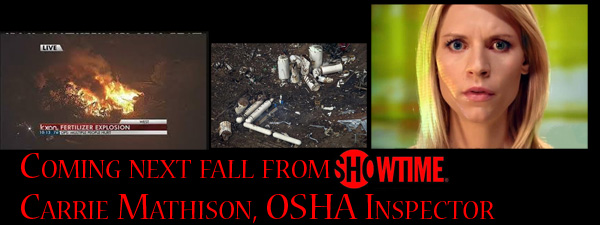
But while we spend more than 7 billion dollars a year on the T.S.A.’s national security theater in which over 58,000 T.S.A. employees make sure we are not carrying too much toothpaste or shampoo onto airplanes, the budget for the Occupational Safety and Health Administration is under $600,000 per year. It seems that our threat assessments are flawed.
We are conditioned to fear persons in caves in Pakistan but not the destruction of our water supply by frackers, massive industrial accidents, climate change or the work-related deaths of 54,000 American workers every year. Fear of outside threats has led us to ignore the more real dangers from within.
The actual threat of shoddy workplace safety and environmental protections is orders of magnitude greater than that posed by intentional terrorists, but no stone is left unturned to catch terrorists, even before they do anything, to say nothing of terror plots hatched and/or enabled by the authorities themselves. In contrast, the “unintentional” terroristswreakers of catastrophic havoc–old-fashioned, red-blooded American entrepreneurs–are given a pass. The pundit class yawns:
Few, if any, of the Sunday TV talk shows discussed the [West Virginia water catastrophe], but imagine the fear that would have been pedaled on those shows if terrorists had poisoned the water of those 300,000 Americans. Of course the danger is the same whether the cause is terrorism or corporate indifference and malfeasance.
Cutting corners to make a buck, deregulating, keeping regulatory agencies toothless to enforce already weak regulations, hey, it’s the American way. Shit happens, and when it does, we’ll pray hard for you, West Virginia….
“The incident that happened with this spill is not related to my view of the EPA, of overreaching and not looking at economics and trying to reach a balance in the energy industries,” Capito said, according to the Charleston Gazette. “I see this as a chemical issue, and so the coal issue is secondary. It’s a product used in the coal industry.”
Gov. Earl Ray Tomblin: “This was not a coal company, this was a chemical supplier, where the leak occurred….. As far as I know there was no coal company within miles.”
“This is a chemical spill accident. It just so happens that the chemical has some applications to the coal industry, just that fact alone shouldn’t cause people to point fingers at the coal industry,” said Jason Bostic, vice president of the West Virginia Coal Association.
One problem with all of this, of course, is that the coal industry is always very insistent that every single job — direct, indirect, induced, whatever — be counted whenever anyone discusses the positive economic impacts of the coal-mining business to West Virginia. If that’s the way the industry and its political supporters want the discussion to go, then they’ve got to own this sort of accident as well.
The other thing, though, is that there are other clear connections between this chemical spill and its impacts and what the coal industry’s effects on West Virginia are like all the time. Plenty of West Virginia communities have watched their drinking water supplies be either polluted or dried up because of coal (see here, here and here). Me and my neighbors are getting a taste right now of what some coalfield residents live with all the time.
And then there’s this, explained most clearly on Friday by the folks at Appalachian Voices:
News reports of Thursday’s spill of a coal-processing chemical into West Virginia’s Elk River—and emergency orders to thousands of people to not drink or use their tap water—are currently focused on the still-unknown potential for direct harm to human health.
But the widespread disruption caused by the spill raises other important questions, including: How could a relatively small-volume spill in one small river cut off drinking water access to roughly 300,000 people across eight counties—16% of the state’s entire population?
An increasing number of private wells in southwestern and central West Virginia, where the spill occurred, have been contaminated by decades of coal mining and processing. One result has been an ongoing expansion of municipal water systems to rural communities that would otherwise rely on well water.
Yes, the well water has been pretty thoroughly poisoned. BY THE COAL INDUSTRY.
What if? What if this had happened to the water supply of the Upper West Side or Arlington or Berkeley? Would the reactions of the federal agencies allegedly responsible been so tepid? Shouldn’t the director of the EPA fly in and distribute water and vow to get to the bottom of this? (Really, this is the agency fighting a “war on coal”?) Where is the president on this? He released disaster money but has not addressed the subject directly. (I’m happy to be corrected on this point.) I think the inertia of the CDC and EPA speaks for itself. (Jedediah Purdy in the New Yorker: “The entire crisis is a tableau of abdication”). Incredibly, the strategy of the federal government is mainly to wait til it blows over.
And maybe it will.
It’s hard for me to think clearly about this catastrophe, so I will simply encourage everyone to follow the indefatigable Ward on twitter. I’m pretty much in awe of his output, and he always seems to be striking the right tone of anger or skepticism or fatalism at the appropriate moments.
But I don’t really think he is fatalistic, or resigned. Maybe this is wishful thinking, or projection, or just delusion, but I think Ward knows, or hopes, that this will be the event that sours people on coal in West Virginia, and the nation. I have been thinking that for days, and then yesterday he sort of confirmed it when he issued this gnomic tweet:
The arc of the moral universe is long, but it bends toward justice.
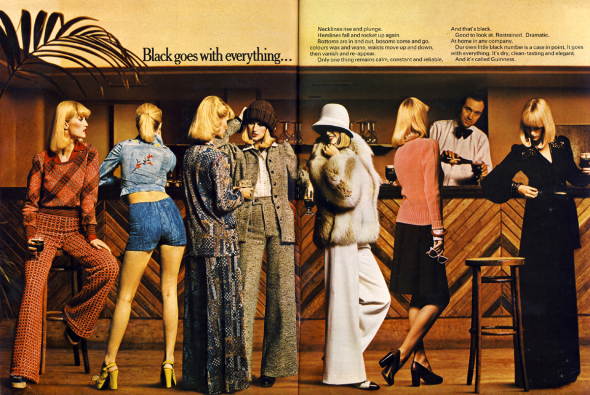
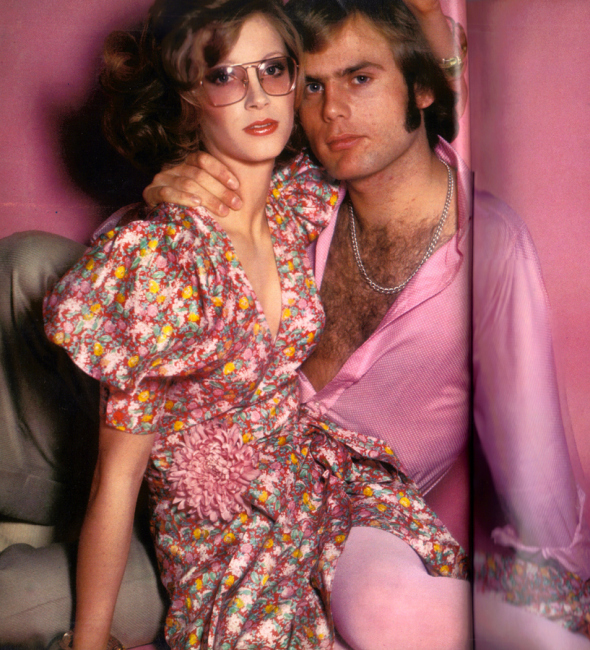
Liz Eggleston’s impeccably and indefatigably curated collection of sixties and seventies images–the glorious, the tacky and the gloriously tacky–mainly from her own scans of British and French magazines, is an unspeakably great treasure. Her focus is on the British Boutique movement, but she confesses to being inspired by “the weirder, even seedier, aspects of popular culture.” This is the kind of amateur (in the French sense) labor of love that the pre-listicle era Internet promised, but really didn’t deliver….
Still processing Andrew Huszar’s remarkable Confessions of a Quantitative Easer, which appeared on the Wall Street Journal’s op-ed page on Monday.
A former Morgan Stanley managing director, Huszar managed the Federal Reserve’s $1.25 trillion agency mortgage-backed security purchase program from 2009 to 2010. Since the crash of 2008, he writes, the Fed has, by one estimate, spent over $4 trillion for a total return of as little as a $40 billion bump in output, which is minuscule (it’s sometimes tough to visualize a trillion dollars. Here is a handy reference.)
This, while BOTH parties insist “we’re broke” (Obama’s very words).
We’re broke, but the Fed can create $4 trillion to loan to the banks. Oh, I see. In return the nation got very little, but for the banks it was a windfall.
Despite the Fed’s rhetoric, my program wasn’t helping to make credit any more accessible for the average American. The banks were only issuing fewer and fewer loans. More insidiously, whatever credit they were extending wasn’t getting much cheaper. QE may have been driving down the wholesale cost for banks to make loans, but Wall Street was pocketing most of the extra cash.
Here is a naive question: If the government can print $4 trillion to give to banks, to very little positive effect for the country, why can’t it print even a fraction of that amount to finance massive public works to make need infrastructure repairs, make education more affordable (or better yet, free), and convert our energy economy to one that is sustainable?
Hell,giving every American a few thousand bucks would be a much more effective stimulus than what the Fed has done.
And don’t forget that the QE program rewards the very entities that created the crisis.
Having racked up hundreds of billions of dollars in opaque Fed subsidies, U.S. banks have seen their collective stock price triple since March 2009. The biggest ones have only become more of a cartel: 0.2% of them now control more than 70% of the U.S. bank assets.
As for the rest of America, good luck. Because QE was relentlessly pumping money into the financial markets during the past five years, it killed the urgency for Washington to confront a real crisis: that of a structurally unsound U.S. economy. Yes, those financial markets have rallied spectacularly, breathing much-needed life back into 401(k)s, but for how long? Experts like Larry Fink at the BlackRock investment firm are suggesting that conditions are again “bubble-like.” Meanwhile, the country remains overly dependent on Wall Street to drive economic growth.
Even when acknowledging QE’s shortcomings, Chairman Bernanke argues that some action by the Fed is better than none (a position that his likely successor, Fed Vice Chairwoman Janet Yellen, also embraces). The implication is that the Fed is dutifully compensating for the rest of Washington’s dysfunction. But the Fed is at the center of that dysfunction. Case in point: It has allowed QE to become Wall Street’s new “too big to fail” policy.
Can’t explain exactly why I’ve been silent here for so long, or why I’m finally prodded into action by this (uncharacteristically) dumb Charles Pierce reaction to the “Obamacare by Morning” schtick at the CMAs the other night.
To these lyin’ eyes, Brad and Carrie’s routine looks like a fairly safe, innocuous jab at a much-discussed current event. And clever. Both in the wordplay and by the fact that it butters up featured CMA guest George Strait, who doesn’t always turn up for awards shows.
Its attitude is pretty closely aligned to this (also very funny) bit from the Daily Show:
But Brad and Carrie really set something off in Pierce:
Let’s forget, shall we, that the act is working gloriously in places like Kentucky, but that places like Tennessee, which hosted the yearly gathering of artificial redneck morons, have decided to sabotage the act because Tennessee insists on electing idiots, which is why there are a lot of the problems for Jethro and Zelda Mae to make sport of on the electric teevee. Let’s also forget how much an actual Medicaid expansion would help in all those Southern states where these posers sell records and that have governors who suddenly find themselves allergic to Free Money (!) Let’s also forget that none of the make-believe goobers on stage last night ever are going to have to make the decision between medicine for the kids and food on the table.
Not a lot to disagree with here on the substance (though I might be cautious about proclaiming “the act is working gloriously in places like Kentucky” until those enrolled actually try to get their claims processed), but what is notable (beyond the embarrassing attempt at country diction) is the contemptuous “How Dare They” vibe. “Jethro and Zelda Mae.” Wow. “Make-believe goobers”! Pierce knows as well as anyone the glaring issues with ACA, and Jon Stewart’s much more critical satire goes unremarked, but country singers making fun of what is looking (sadly) to be a prototypical product of 21st century (neo)liberalism is just too much for Mr. Pierce to bear.
First the ad hominem, and then the revealing obiter dictum.
Let’s forget all of that and concentrate on the main issue — which is that I think modern country music sucks gigantic bowls of monkey dick. It is, weight for age, the phoniest genre of music since Pat Boone was ripping off Little Richard. Most of what is celebrated as “country” these days is simply bad rock and roll played by people who look like they flunked the audition for a Night Ranger tribute band. I mean, Taylor Fking Swift is already a “legend,” and Patsy Cline would have eaten her on toast.
Stop the presses. Boston-based writer derides current country music as fake, knows what REAL country music is.
Pierce then moves on to the musical question “You know what coutry music is?” and name checks Guy Clark, Townes Van Zandt, Steve Earle and Harvard Divinity School dropout Gram Parsons. I’m a fan of all of these guys, but every one of them is a middle-class white dude, applying a bookish veneer to the country genre. To Pierce’s credit he does mention Loretta Lynn, but doesn’t link to any of her iconic songs (you know, the ones a Jethro or Zelda Mae might know), but to “Van Lear Rose,” from the all-over-the-place album she did with another slummer, hipster Jack White.
Which is a little weird. And where am I going with this exactly?
A first bash: patronizing east coast writer’s take can be summarized as: these rubes don’t know what they want (the ACA), or even what they like (debased country music, not the “real” stuff), and they sure as shit don’t know what’s good for them. There’s a lot of the crazy in Southern-identified folks mistrust of Yankee superciliousness, but sometimes there’s some justification….
Country music left its rural roots behind at least as far back as the (then-maligned, now celebrated) countrypolitan era. It’s been a suburban thing for half a century, so the Jethro and Zelda Mae jibe is kind of out of the blue. Are Brad and Carrie trying to act like hicks? Does Carrie Underwood have her teeth blacked out? Not exactly. Say what you will about her outfit here but … not exactly. (OK. Paisley does wear a cowboy hat. It’s a Nashville thing, a shorthand connection to country’s real country (distant) past. Also, a godsend for artists with receding hairlines.)
Ian Crouch’s dispatch in the New Yorker, while still a tad glib, at least indicates that he actually saw the CMAs and didn’t just fly off the handle because OMG these rubes were making fun of Obamacare.
And the music itself, as always, has one foot in respectability and the other in foolishness. The best-selling country album in the United States right now is a Christmas collection recorded by the family from “Duck Dynasty.” One of the tracks, “Away in a Manger,” features the vocals of Alison Krauss. It’s still a weird swamp down there in Nashville.
Weird swamp indeed. And it has always been so. As someone who listens to a lot of country music, both old (“authentic”) and new (“bogus”), I have a lot of problems with contemporary music trends, but beg to differ with the notion that today’s country stars are talentless hacks. All of them are in possession of major chops, as players, singers or writers (or all three) or they wouldn’t be on the CMA stage rubbing elbows with Vince Gill.
Random anecdote: I recently had a quick overnight visit to Nashville. Three friends and I went out to see some music. Being cheap–we only went to free bars, –and old–our night started at 5 and ended before midnight–, we were exposed to the absolute bottom tier of Nashville talent (it was a Sunday night too) but I found it pretty remarkable that everybody at that level could really play and sing. There are tens of thousands of full-time musical strivers between these cover musicians and the Carries, Brads, and yes, Taylors. Country is another classic American winner-take-all, long-shot business–like the movies, pro sports, and fashion–but the problem is never the talent. The business of Nashville is just like those other show biz machines. It mercilessly molds artists into a template that is predictable and sells. But the talent shows through, it always has. Personally, this is why I pay attention to any pop culture: genius, of some sort, rising above an overly rigid framework. The auteur theory of country music, to get all grad schoolier than thou.
A common tactic of those who argue for a false Golden Age of anything is to set up a dubiously intense competition between artists of yore and the poseurs of today. So “Taylor Fking Swift is already a ‘legend,’ and Patsy Cline would have eaten her on toast”. I disagree. If Patsy and Taylor had been contemporaries, they would have collaborated dozens of times.
To be even more contrary, I would go so far as to say that we are in the midst of a Golden Age of Nashville, for female singers and songwriters, at least. In thirty years, a crusty writer will spit when mentioning the current crop of fake country talent, fix you with a steely gaze, jab a bony finger in your chest and say, “Now Miranda Lambert. There was a true badass country singer.” (And so she is)….
Once again stuck for a way to end this, am bailed out by the great Robbie Fulks, who has noticed the tendency of Yankees to preach to country folks what real country is. I love the weird and wonderful adjectival mouthful below, and think Pierce might find himself somewhere in there. He certainly will see his reflection in the opinionated, overalled Bostonian (cue to 2:22).
Not a hillbilly dilletante, fair weather hick, demi-clod, faux po’folks, well-readneck…
Robert-E.-come-lately hayseed wanna-be undercover Yankee…
Mississippi Ph. D., Alabamateur, 50% less Tarheel armchair Arkansan
http://ghastlyandawful.tumblr.com/ fashion photography
I always feel I have to explain myself for the last one, but a long time ago I was held captive in a small office at Conde Nast, when it was still at 43rd and Madison. I was a poorly paid temp assistant for none other than Andre Leon Talley. While he was away in London, Paris and Milan, I spent entire days browsing through bound volumes of Vogue back issues. Have been addicted to fashion magazines ever since, but never enough to become a fashionable person.I am fascinated by fashion in the same way that I am fascinated by college football. Both offer the amazing and appalling in near equal measures. No plans on a college football tumblr at the moment, however.
I plan to keep dowackado.com going for a while, because I actually read it from time to time, and because one day I hope to summon the energy to write at (greater) length. But I hate repeating myself and that is what I seemed to be doing in the last year.
My time being limited today, I just wanted to highlight three apt quotes included in Greenwald’s article.
1.Teju Cole in Mother Jones
Killing a bunch of people in Sudan and Yemen and Pakistan, it’s like, ‘Who cares – we don’t know them.’ But the current discussion is framed as ‘When can the President kill an American citizen?’ Now in my mind, killing a non-American citizen without due process is just as criminal as killing an American citizen without due process – but whatever gets us to the table to discuss this thing, we’re going to take it.
2. Thomas Jefferson
In questions of power . . . let no more be heard of confidence in man, but bind him down from mischief by the chains of the Constitution.
3. Frederick Douglas
Find out just what any people will quietly submit to and you have the exact measure of the injustice and wrong which will be imposed on them.
About Rand Paul’s filibuster the other night: Initially I was thrilled, but in the cold grey light of morning, it seems its most lasting effect will be limited to advancing Paul’s political fortunes.
It certainly exposed a rift between Paul and the Old Guard Republicans, who clearly seem unnerved at this challenge to the never-to-be-questioned primacy of the Military Industrial Gravy Train.
“What is it, all of the sudden, that this drone program has gotten every Republican all spun up?” Graham asked. He said that many are ‘astonished’ that Obama has continued President Bush’s war on terror. “I’m not astonished, I congratulate him for having the good judgment to understand we’re at war,” Graham added.
“To my party, I’m a bit disappointed that you no longer apparently think we’re at war,” he observed. “Not Senator Paul, he’s a man to himself. He has a view that I don’t think is a Republican view – I think it’s a legitimately held libertarian view.
Graham [also] slammed Paul for failing to sign a resolution in which the Senate professed its refusal to accept a nuclear-capable Iran.
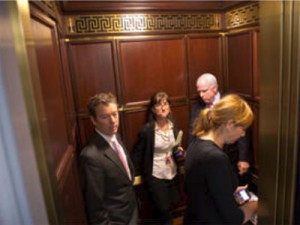
McCain also had harsh words for Paul’s “stunt” and the pair had what must have been an incredibly awkward elevator ride together (shown in the image above).
So, are we any closer to progress here? Republicans (some of them anyway) spoke up in support of the filibuster and forgive me if I don’t quite believe they have become converts to the cause of civil liberties. It was simply an opportunity to get on television with the cameras rolling. The Democrats, who might be expected to have a civil libertarian or two among their ranks,* simply circled the wagons around their president and his scary nominee for CIA director. As Glenn Greenwald tweeted yesterday: “4 years ago, Brennan’s advocacy of torture forced him to withdraw for top CIA spot; now, all Dems except 2 vote to confirm him. #ObamaLegacy”.
You should never put faith in a politician to be jury, judge, and executioner.
In the GWOT decade we have seen successive, and mutually exclusive, fatuous personality cults built around whoever was sitting in the White House. Partisans of both parties would do well to put Kirell’s statement on a plaque somewhere in their offices. To me the distinctions between killing Americans on American soil vs. killing them overseas vs. killing non-Americans are really distractions from the major question: does any person, or group, have the right to sentence anyone to death based on secret criteria?
I’m hoping that years from now we will be able to look back on the past decade as an aberration, and we will revert to a time when extrajudicial assassination was, rightly, considered an appalling manifestation of an imperial mindset. Hoping, but not counting on it.
____
* OK there were exactly two, but one wished for more maybe?
As a lover? Well, obviously not as energetic and inexhaustible as Jeremy. And though Tony was in good shape for his age, I was a little put out first time to see what fifty-four years could do to a body. He was sitting on the edge of the bed, bending to remove a sock. His poor naked foot looked like a worn-out shoe. I saw folds of flesh in improbable places, even under his arms. How strange, that in my surprise, quickly suppressed, it didn’t occur to me that I was looking at my own future. I was twenty-one. What I took to be the norm–taut, smooth, supple–was the transient special case of youth. To me, the old were a separate species, like sparrows or foxes. And now, what I would give to be fifty-four again! The body’s oldest organ bears the brunt–the old no longer fit their skin.
–Sweet Tooth, Ian McEwan
Really quite enjoyed the book, the milieu (“the post-60s England of strikes, bomb blasts, oil crises, cold war escalation, ideological grandstanding and generally impending anarchy….”)…
… and for some reason (perhaps an impending 54th birthday?), I absolutely love the passage quoted above.