Cryopreservation: Swine of the times

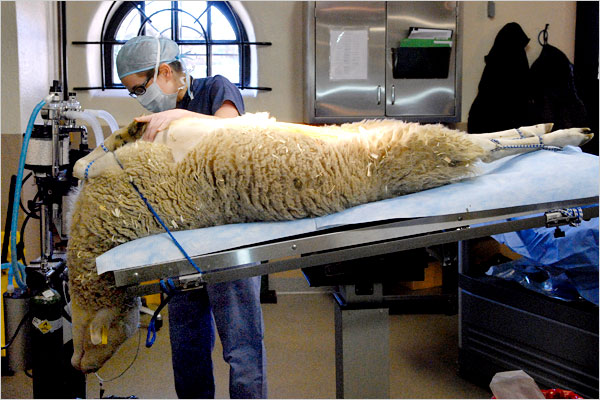
surgery on a sheep
Sheep surgery at the SVF Foundation. photo: New York Times

Is it quibbling to question  the New York Times’ decision to run Rare Breeds, Frozen in Time in the Dining and Wine section, instead of the Science Times?

The story is about the SVF Foundation, a livestock preservation farm/lab that freezes and stores the sperm and embryos of heritage breeds. The writer, Barry Estabrook, does a good job in sketching out the potential catastrophe underlying current industrial livestock techniques, which (in)breeds so aggressively for value-adding uniform characteristics that it weakens the genetic makeup of popular lines. Holsteins, for example, “make up 93 percent of America’s dairy herd. Fewer than 20 champion bulls are responsible for half the genes,” according to the Holstein Association USA.

“Think of this as a safety valve program,” said Dr. George Saperstein, the [SVF] foundation’s chief scientific adviser, who is chairman of the Department of Environmental and Population Health at the Cummings School of Veterinary Medicine at Tufts University. “If there was a disaster, if something like the potato famine of livestock ever hit, these frozen embryos [of selected heritage breeds] would be made available, and in one generation we would be back in business.”

Peter Borden, SVF’s executive director, explains the obvious advantages heritage breeds present. They “have not been continuously ‘improved’ by humans…. They have been shaped by natural survival-of-the-fittest forces and can get along without human intervention.”

What a concept. An animal unimproved by man! This is in marked contrast to the modern “standardized”  factory hog as portrayed in Nathaneal Johnson’s terrific 2006 Harper’s article Swine of the times: The making of the modern pig. (Such a good title. Couldn’t resist stealing it.)

The goal of modern factory livestock farming is the same for pork, beef, chicken, whatever. The business model, based as it is on efficiency and massive scale, finds it desirable to have “standardized” animals that grow at predictable rates and produce predictably uniform meat. The uniformity is necessary for, among other things, the slaughterhouse assembly line, one of the highest expressions of the deranged genius of industrial agriculture.  Writes Johnson, “As swine carcasses move down the conveyor belt, at Hormel’s Austin, Minnesota, packing plant, they hit a curved knife, which slices the cylindrical loin from the inside of the body cavity. If the animals aren’t just the right proportions, the knife will hit the wrong spot, wasting meat or cutting into bone.”

That dystopian assembly line was the single image that stayed with me, and creeped me out, since I first read Johnson’s article.  Of course there are no tradeoffs for this uniformity, right? Wellllllll….. Writes Johnson:

The modern pig is so susceptible to disease that producers must take extreme measures to transform their barns into pathogen-free bubbles. The pigs are vulnerable because they live in close quarters; and because they are genetically uniform, a bug that breaches the defenses of one pig’s immune system can hop to the next. A bacterium stowing away between a traveling boar’s toes could wipe out half a herd.

Johnson paints the most vivid and frightening picture of modern industrial agriculture I’ve come across. It would give PETA-sympathetic folks conniptions.

In just a little more than a decade, the modern hog industry has produced a tower of efficiency-maximizing products, one stacked atop the next, each innovation fixing the problem the last fix created. It is a monumental if somewhat haphazard structure, composed of slatted floors and aluminum crates, automatic sorting scales and mechanized wet-dry feeders. It is constructed of Genepacker sows, Tylan antibiotic feed, Agro-Clean liquid detergent, Argus salmonella vaccine, Goldenpig foam-tipped disposable AI catheters, CL Sow Re-placer milk substitute, and Matrix estrus synchronizer.

Brilliant system, right? What could go wrong?

Sorry, I digressed a bit as I revisited “Swine of the times.” (Really a must-read, and it’s not behind the famous Harper’s firewall, for all you cheapskates who don’t subscribe to the world’s best magazine). Back to the Times article. It’s well worth a look, and the companion slide show is good too.  I just found it a little odd that the emphasis at the top of the article went on about “cutting-edge restaurants”* and “the next food trend” when much bigger issues, like the precariousness of the  food supply, are really what’s at stake here.

___________

* and speaking of “cutting-edge restaurants”: when did it become conventional to prepend the chef/proprietor’s name to every mention? “David Schuttenberg’s Cabrito in the West Village, Rick Bayless’s Frontera Grill in Chicago and Tom Douglas’s Lola.” Annoying! I take off my hat to the restaurant PR flacks who made this a matter of journalistic policy at the Times.

dystopian

Detroit as the canary in the coal mine

Diego Rivera mural
"deities waiting to reclaim the world"

Marcy Wheeler has an interesting post on “the increasingly urgent efforts to turn Detroit back into an agricultural bread basket.”

Apparently, companies are buying up large abandoned chunks of the Motor City with the idea of turning the lots into “a large-scale commercial farm enterprise.”  Another, better established (and just plain better)  model involves the rapidly growing network of community gardens, some of which feed students in over forty city schools.

Marcy’s conclusion echoes some of my thinking recently: that, like it or not, we might well return to being a nation of farmers. The question is what kind of farmers will we be?

Detroit has long been a symbol of America’s industrial might. And yet, quickly, it has become a symbol not only of decay, but of the earth reclaiming the land. Frankly, I’m in favor of using Detroit’s vacant space for farming (though I prefer it to be organic, small scale farming). But if Detroit is the canary in the coal mine of industrial society, we need to start preparing to return to an agricultural way of life.

For more, there’s this wonderful Harper’s essay by the great Rebecca Solnit, Detroit arcadia: Exploring the post-American landscape. “Surrounded, but inside that stockade of racial divide and urban decay are visionaries, and their visions are tender, hopeful, and green.”

Everyone talks about green cities now, but the concrete results in affluent cities mostly involve curbside composting and tacking solar panels onto rooftops while residents continue to drive, to shop, to eat organic pears flown in from Argentina, to be part of the big machine of consumption and climate change. The free-range chickens and Priuses are great, but they alone aren’t adequate tools for creating a truly different society and ecology. The future, at least the sustainable one, the one in which we will survive, isn’t going to be invented by people who are happily surrendering selective bits and pieces of environmentally unsound privilege. It’s going to be made by those who had all that taken away from them or never had it in the first place.

Solnit concludes with this bit, about an “odd masterpiece,” the massive Diego Rivera mural at the Detroit Institute of Arts (“painted by a Communist for the son of one of the richest capitalists in the world [Edsel Ford, who commissioned the piece]”):

That Rivera mural, for instance. In 1932 the soil, the country, the wilderness, and agriculture represented the past; they should have appeared, if at all, below or behind the symbols of industry and urbanism, a prehistory from which the gleaming machine future emerged. But the big panels of workers inside the gray chasms of the River Rouge plant have above them huge nude figures—black, white, red, yellow, lounging on the bare earth. Rivera meant these figures to be emblematic of the North American races and meant their fistfuls of coal, sand, iron ore, and limestone to be the raw stuff of industrialism. To my eye, though, they look like deities waiting to reclaim the world, insistent on sensual contact with the land and confident of their triumph over and after the factory that lies below them like an inferno.

All these wars: some questions

old war bond ad
How quaint! We once had to pay for wars

Who among us has the time, or indeed the inclination, to pore over the myriad (and I think deliberately obtuse) reports in the major media outlets about our five, count ’em, FIVE fronts in the glorious global war on terror? Tom Englehardt does, thank God! In The Year of the Assassin, Englehart and Nick Turse ponder ten pretty fricking important questions about the coming year for America and its multiple battle fronts, so bizarrely disconnected from daily life in the homeland.

We, of course, think of ourselves as something like the peaceable kingdom.  After all, the shock of September 11, 2001 was that “war” came to “the homeland,” a mighty blow delivered against the very symbols of our economic, military, and — had Flight 93 not gone down in a field in Pennsylvania — political power.

Since that day, however, war has been a stranger in our land.  With the rarest of exceptions, like Army psychiatrist Major Nidal Hasan’s massacre at Fort Hood, Texas, this country has remained a world without war or any kind of mobilization for war.  No other major terrorist attacks, not even victory gardens, scrap-metal collecting, or rationing.  And certainly no war tax to pay for our post-9/11 trillion-dollar “expeditionary forces” sent into battle abroad….

Although our country delivers war regularly to distant lands in the name of our “safety,” we don’t really consider ourselves at war (despite the endless talk of “supporting our troops”), and the money that has simply poured into Pentagon coffers, and then into weaponry and conflicts is, with rare exceptions, never linked to economic distress in this country.  And yet, if we are no nation of warriors, from the point of view of the rest of the world we are certainly the planet’s foremost war-makers.  If money talks, then war may be what we care most about as a society and fund above all else, with the least possible discussion or debate.

The article really deserves to be read in full, but I’ll just offer an excerpt from the first question, “1. How busted will the largest defense budget in history be in 2010?”:

If you want to put a finger to the winds of war in 2010, keep your eye on something else not included in that budget: the Obama administration’s upcoming supplemental funding request for the Afghan surge. In his West Point speech announcing his surge decision, the president spoke of sending 30,000 new troops to Afghanistan in 2010 at a cost of $30 billion. In news reports, that figure quickly morphed into “$30-$40 billion,” none of it in the just-passed Pentagon budget. To fund his widening war, sometime in the first months of the New Year, the president will have to submit a supplemental budget to Congress — something the Bush administration did repeatedly to pay for George W.’s wars, and something this president, while still a candidate, swore he wouldn’t do. Nonetheless, it will happen. So keep your eye on that $30 billion figure. Even that distinctly low-ball number is going to cause discomfort and opposition in the president’s party — and yet there’s no way it will fully fund this year’s striking escalation of the war. The question is: How high will it go or, if the president doesn’t dare ask this Congress for more all at once, how will the extra funds be found? Keep your eye out, then, for hints of future supplemental budgets, because fighting the Afghan War (forget Iraq) over the next decade could prove a near trillion-dollar prospect.

Ethics, tactics, drones, counterterrorism (“which is just terrorism put in uniform and given an anodyne name”). We should all be up to speed on each of these subjects, and there should be a ferocious debate in our media and Congress. Fat chance.  Last week, a truly horrible story surfaced and was pretty much ignored by our major news outlets. “The occupied government of Afghanistan and the United Nations have both concluded that U.S.-led troops recently dragged eight sleeping children out of their beds, handcuffed some of them, and shot them all dead.”

Really, you’d think there would be more of a fuss…..

New Decade: Fallin’/flyin’

At the dawn of the Millennium, my Monday mornings as a New York City cubicle warrior involved a leisurely routine of coffee drinking, subway riding (I went in a little late so I could have a seat), and  paper reading. Then I got to the office, and commenced to Web surfing and chatting with work buddies.  And eventually working, some days more than others. When I was sick or on vacation, I got the direct deposited check just the same. At the time, I felt underpaid, but from my perspective today, my salary in the year 2000 now seems like a fortune. It was a simple trade-off, my time and brainpower to further the goals of a major media organization whose overall effect on the world can at best be described as neutral.

I wanted something more. Emboldened by another small fortune, the meteoric appreciation in value of an old house in Brooklyn we bought at just the right time, my wife and I agreed it might be a good idea to revisit her ancestral abode and try living on a farm in central Kentucky. We had a bunch of money from the sale of the house, and the stock market would generate more than enough income to live on, even if our ventures didn’t pay the bills.

Needless to say, it didn’t work out quite that way. A decade passed, the larger world has become incredibly precarious, and I am the father of three with not a hell of a lot of earning power.

It’s still true that the rewards of this life are pretty exhilarating. Coming outside on a spring morning to see a new calf, born overnight, standing and suckling; eating meals entirely from our garden and livestock; watching a cloud of starlings at dusk a hundred yards long.

But on a morning like this a song from Crazy Heart comes at me pretty hard: Fallin’ feels like flyin’ for a while (or words to that effect).  All the intangible benefits of this life are wonderful, but what we’ve given up  in comfort and security sometimes seems like a lot. This morning, for example, waking to a house that is never warm enough in winter, in a week where the temperatures will top out in the low 20s every day, getting the kids off to school, then wriggling into my Carhartt jumpsuit, trudging outside on the crusty ground, moving a ramshackle hay ring, held together with wire, to a  new hay bale so my cattle can eat.  Today, it’s hard to see this as flyin.’

[vodpod id=Groupvideo.4343198&w=425&h=350&fv=%26rel%3D0%26border%3D0%26]

more about “Crazy Heart Movie Trailer http://movi…“, posted with vodpod

Here’s the beef

Very proud of myself.  This Thursday marked the culmination of a two-year dream to raise and process my own beef.  Dicky, an affable, professional butcher from Moore’s Meats, made a house call to our  farm, and killed, skinned and quartered a young steer, one of the fourteen thirteen cows in the herd I’ve been raising since last spring.

Naturally, for this city boy there was a degree of emotional discomfort to see a large, complex animal felled with a shot to the head, and transformed into meat before my eyes.  We are not so sentimental that we name our cattle, but the steer in question, #18, had a personality. He was fearless and curious and docile, if that makes any sense.

But  perhaps the best thing about the emotional aspect of this affair was that my stress level on the day was higher than the steer’s ever got. His heartbeat might have quickened a fraction when he smelled the strange man walking towards him, pointing a long stick … but that was it. #18 never had to experience the disorientation and panic of being loaded, transported, crowded and harassed in his last hours.

So that was a good thing. Also, the fact that he got to this nicely rotund body condition while eating an exclusive grass/hay diet.  He wasn’t stuffed with grain, and never saw an antibiotic. He had nothing to do with the massive, and massively ugly, industrial cattle production system. Since he came to our farm at about three months of age, he never left it. He spent no time standing up to his ass in mud and shit in a feedlot. No trucks, no gasoline, no corn or beans or fertilizer or herbicide were involved in his raising (OK. Maybe minimal amounts of gasoline).

Yay, me.

I ain’t gonna lie. This wasn’t easy. There was a good deal of labor involved, nearly all of it supplied by yours truly. When the grass is growing, I moved my herd to a new paddock every day by moving electric wire with portable step-in posts. And when the grass is not growing, the procurement and placement of hay, combined with doing constant battle with Kentucky mud (mixed with cow piles), is an unrelenting (and pretty unpleasant) challenge. As is doing all of this without the purchase of tractors, trailers, handling equipment, ATVs and four-wheel-drive trucks. That’s the trade-off. More labor in exchange for keeping expenses, debt, and  inputs to an absolute minimum.

My one big insight into agricultural endeavors, especially those involving “alternative” techniques, is that it takes years to see the true benefit of your efforts. Or detrimental effects. Going by the inspiration of books by Wendell Berry, Gene Logsdon, Joel Salatin, and others, and regular reading of crackpot (in the best sense) publications like Stockman Grass Farmer and Eatwild.com, I’m trying to do my humble part in a reinvention (0r rediscovery) of American agriculture. I  like to think I’m stumbling forward. It would be nice if my farming skills were not so rudimentary, but they are, and they will have to do ….

Rahm sez: “NAFTA = Good Times!”

Easy credit ripoffs. Good times!

White House Chief of Staff Rahm Emanuel has been telling Democrats a win on the health issue will reverse the slide in public opinion, just as passage of another controversial proposal, the North American Free Trade Agreement, lifted President Bill Clinton in the polls.

Wall Street Journal, “Democrats pin 2010 hopes on bill”

In an only slightly different context a wise person said, “It’s scary to think that people this obscenely stupid are running the country.”

More on Jane, Grover and Rahm

All I know is the Hamsher/Norquist joint venture caused many Obama loyalists to pee their pants, and got a lot of positive comments on Jane’s own site. Not exactly surprising.

Someone asked about it on the President’s plane and was met with a predictably smug reply, that the Chief of Staff’s job was “very safe”.

And also: over the Christmas weekend the White House announced that the caps on Fannie Mae and Freedie Mac losses would be lifted. There was talk that they would be raised from $400 billion to $800 billion, but no. They have been raised, to, uh, infinity.

Did Jane Hamsher really whack Rahm Emanuel upside the head, as Cenk Uygur claims? If so, was it with a Nerf bat, or a 2 by 4 with a nail sticking out of it? Is he PISSED? Just mildly annoyed? More important, Will this be enough to shame the White House into taking any real judicial/investigative action with regard to Freddie Mac, like letting Inspector General Ed Kelley get back on the job? You know, 6 trillion dollars is a lot of money.

more about "Jane Hamsher Hits Rahm Emanuel Over t…", posted with vodpod

odd couple: jane and grover join forces against rahm

Hugely unlikely bedfellas Jane Hamsher and Grover Norquist have teamed together to demand Rahm Emanuel’s resignation, over the White House Chief of Staff’s “activities at Freddie Mac, and the White House’s blocking of an Inspector General who would look into it.”

This is sure to raise the hackles of lefties who despise Norquist and of conservative-identified folks for whom Hamsher is the SheDevil incarnate. But after that settles down, what will it mean? Will a coalition of ideologically opposed outsiders be able to gain any traction at making life difficult for America’s Number One insider political figure? And will it change anything about the corporate ownership of the political process?

Honestly, I have no idea. My hope is that it will.  And I’ve become comfortable with this for some time.  As a longtime reader of antiwar.com, whose masthead bears the names of both Pat Buchanan and John Pilger, and represents an alliance of libertarian, paleocon, and old-school lefty antiwar sentiment. Sometimes it gets weird.

Eventually, the corruption of the Washington D.C. political/corporate united front will collapse in on itself, and the two-party system will have a hard time containing the fallout. This move by Hamsher and Norquist might still be too early, or it might be perfectly timed. It remains to be seen.  But the contempt of the political class for what used to be called democracy has never been greater.  Whatever her motivations may be, I’m glad to see Jane rolling the dice on this one.

Update:  Didn’t take long for the firestorm of reaction, hurt feelings, and name-calling to break out (read the comments to this post), nor did it take long for Jane to issue what is sure to be the first of many apologia (I am not entirely sure what the plural for apologia is, sorry):

Rahm Emanuel is destroying not only the Democratic majority but the Democratic Party.  There isn’t enough pork in the world to hold his “Blue Dogs” in office with the legacy of bailouts that he has engineered, and that’s why his “big tent” is now collapsing in his wake.  Parker Griffin, and now (possibly) Chris Carney, may blame Nancy Pelosi for their defections to the GOP, but that’s pure demagogurery. The mess they are fleeing — the corrupt back-room deals, the endless bailouts — belong to Rahm.

The ground is shifting. You can feel it. And the Rahm dead-enders have become no different than the Bush dead-enders, completely unaware that the President whose malfeasance they are defending on the basis that one must not “consort with Republicans” is the one who ran on — consorting with Republicans.  It is knee-jerk authoritarianism in the extreme. Rick Warren is okay because Obama says so. Principles? Who needs them.

If Obama/Rahm want to triangulate against progressives (and they do), they’re not the only ones who can make cause with people on the other side of the aisle.  If that’s what it takes to shake up the corporate domination of our political system, we’ve done it before and we can do it again. Because working within the traditional political order to support “progressives” whose conviction lasts only as long as it doesn’t matter just doesn’t seem to be working.

She’s good. And she’s got my vote.

Anxiety of influence

Truly a terrific scene from Chuck Berry: Hail! Hail! Rock ‘n’ Roll, Taylor Hackford’s amazing 1987 documentary. The master shows the  student, better compensated by several orders of magnitude, who’s the boss. Priceless interaction. What can I say? I’m a fan of both of ’em.

more about “Agony of influence“, posted with vodpod
Scroll to top