I re-upped my annual hosting charge for this blog, or rather I let the automatic renewal happen. With all the many free ways to express oneself online, I’m already feeling a little buyer’s remorse…. But hey, Blogging is back! (Maybe…) What’s old is new. And the war that never ended is beginning all over again!
So, endless war w/vague unattainable goals? RT @nytimes: Breaking News: Obama to Compare Plan for ISIS to U.S Fights in Somalia and Yemen
In lieu of actually writing something, an announcement. I have made a few small changes.
The “dowackiest posts” was a little out of date, so I added a couple of my more recent pieces.
Took down my “blogroll”, which is kind of an outdated concept in this age of twitter feeds and RSS, no?
And I’ve gathered in one place a list of all manifestations of my fragmented social media self, such as it is, appear. I am much more of a twitter person these days. I don’t know if it’s a good thing. I am probably more au courant, but maybe I don’t want to be that way. On days where I own the Slate news quiz, I’m often thinking, “These things are really not that important…”
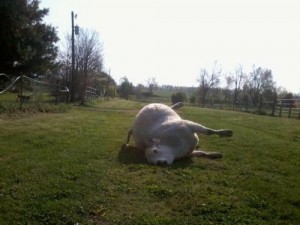
It’s weird that, having always been an early adopter, it took me so long to become a user of smart phones. Yeah, they’re ok, I guess. I admit I love taking pictures of cows with my Moto X. Never felt comfortable lugging around my D-70 in the pasture. But now I can go “Cow crazy,” in my wife’s apt phrase…..
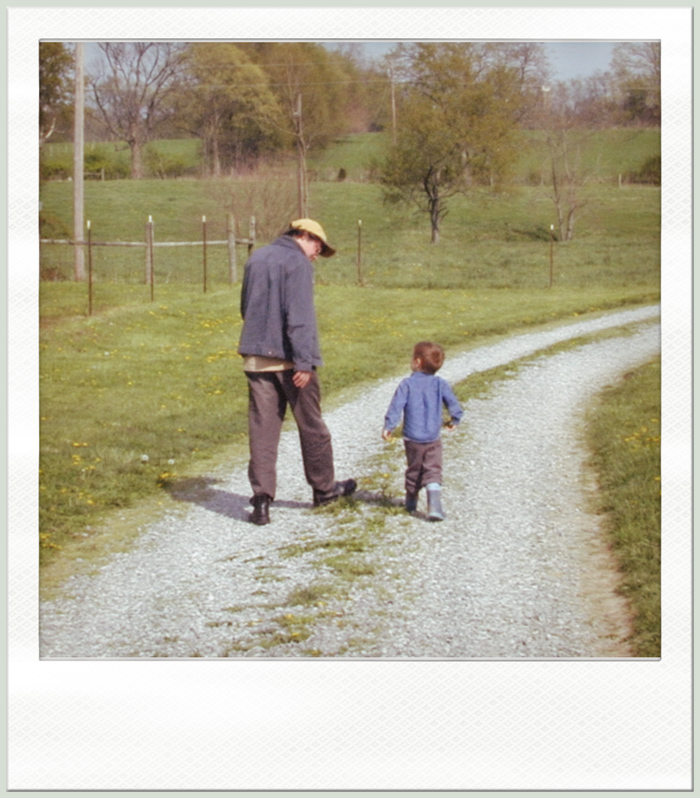
Riding together in the back seat. I (dad) am driving.
Theo: Yeah, Daniel’s bowling ball is really cool. Leo: (after a long pause) I got my roller blades fixed. Theo: (pointing at back of my head) I like dad’s haircut. It’s cool. Dad (me): Do you like it like this, or did you like it long? Leo, I know you like it long. (I say this because Leo has long hair)… Theo: Oh, no. Leo told me he wants to cut all his hair off. Leo: (after another pause): Well, yeah, I do want to get a hair cut. I just don’t want it to be painful.
Re-upping a thing I wrote after finishing To End All Wars last summer. Seems an apt thing to share on Memorial Day weekend….
To me it’s amazing that any of the generals and leaders of The War To End All Wars–one hundred years old today!–had statues built in their honor. The elites of western civilization, whose slight brainpower kindled by their limitless arrogance erupted into the conflagration that came to be known as the “great” war. A war so great that two decades later they did it all again.
***
During a visit with my aged father not long before he died, I found myself thumbing through a volume of my family’s genealogy I didn’t know existed. I came upon an entry for a distant relation whose family had immigrated from what is now Germany in the mid-nineteenth century. He lived his entire life on a farm not far from the Mississippi River in a gorgeous corner of Iowa. When the United States entered the First World War, my distant relation left the farm and went back to Europe, where he lasted a few months. What happened? He died. How? Blown to bits by a shell? Forced at gunpoint to go over the top and mowed down? The record does not say. Just birth date and place, where he grew up, and when and where he died.
Reading or listening to Berry read this story is something I plan to do every year on Memorial Day.
***
By luck, one of the sample pages on amazon.com happens to contain some of the most powerful writing.
***
“They talk about victory as if they know all them dead boys was glad to die. The dead boys ain’t never been asked how glad they was. If they had it to do again, might be they wouldn’t do it, or might be they would. But they ain’t been asked.”
There is a depressing air of plus ça change about this siege of Gaza, but there is something else as well.
At times I think this will play out much like the previous Israeli operations that sound like they have been named by children who will grow up to be psychotic adults. Israel will kill five hundred or a thousand more civilians and find some pretext to stop and get out, and we will wait a year or two for the next atrocity. But maybe not.
The world’s media are more horrified and outraged with each passing day. Israel’s spin is along the absurd lines of “self-genocide” (Naftali Bennett) and that Hamas is “deliberately wag[ing] war so that your own people can be telegenically killed” (Krauthammer, quoted approvingly by Netanyahu). The message the Israelis are putting forth is transparently weak, tone-deaf, and odious. So far, the US political establishment and mainstream media are toeing the line, but perhaps not for long. (Among mainstream reporters, Anne Barnard has been terrific for the Times, not known for its balance on Middle East topics). Reading reports from inside Israel, it is scarily apparent that the nation has descended into mad racial panic and aggression more quickly than the most pessimistic could have imagined.
Netanyahu, monster that he is, certainly deserves his day in front of an international criminal court. But, in no small part thanks to his genius for racial incitement and provocation, has been eclipsed by his one-time followers. In the landscape of Israeli fanaticism, he has become something he never imagined, a moderate. His ugly rhetoric now appears to be weak sauce compared to that of Moshe Feiglin, Deputy Speaker of the Knesset, with his steely-eyed and lunatic idea to expel all residents of Gaza into the Sinai before flattening the place, and rising Home Party star Ayelet Shaked, who quoted Uri Elitzur charming words about Arabs on her facebook page (to thousands of “likes”:
they are all enemy combatants, and their blood shall be on all their heads. Now this also includes the mothers of the martyrs, who send them to hell with flowers and kisses. They should follow their sons, nothing would be more just. They should go, as should the physical homes in which they raised the snakes. Otherwise, more little snakes will be raised there.
Again, I have absolutely no sympathy for Netanyahu, but I can see his predicament clearly now. From behind, in Israel, there is a loud call for blood. Abroad, he knows there are limits on how far he can take his butchery. He has to find that Happy Place where the Israeli right is satisfied with his cull of Arabs (for that is what this operation is, at bottom), without horrifying the west to the point of taking meaningful action. Complicating things is that Hamas is putting up a much better fight than was expected, and in spite of the heavy losses it is sustaining, is emerging as the clear leader of the Palestinian resistance. Samantha Power is making noise about partnering with the hapless Abbas.
I don’t know how this will play out. I don’t think anyone does.
All I can do here is share what I have been reading.
About ten days ago, at the beginning of Israel’s assault on Gaza, JJ Goldberg, self-described “devout Zionist” published an incredibly damning piece on Netanyahu’s machinations. Its main points have turned up elsewhere since then, but for me it was the first laying out of a chronology that has been (purposefully) blurred. No, Hamas did not break the ceasefire. Netanyahu told two egregious lies about the kidnapping of three yeshiva students — one, that Hamas was responsible, and two, that that a massive hunt for the kidnappers was necessary. And so it came to pass. Mouin Rabbani, in another essential essay, described the hunt as ” really an organised military rampage” that involved
the killing of at least six Palestinians, none of whom was accused of involvement in the disappearances; mass arrests, including the arrest of Hamas parliamentarians and the re-arrest of detainees released in 2011; the demolition of a number of houses and the looting of others; and a variety of other depredations of the kind Israel’s finest have honed to perfection during decades of occupation.
At a security briefing on July 9, Israeli Prime Minister Netanyahu said the attack on Gaza “will expand and continue until the fire on our communities is over and the quiet is back.”
But the key thing to note here is that Israel alreadyhad quiet. In the West Bank, the Palestinian Authority provided years of quiet through security cooperation with Israeli security forces. Yet Netanyahu’s response to this unprecedented calm — which Israel had long sought — was to undermine his ostensible partner Abbas at every conceivable opportunity through settlement construction, incursions into Palestinian cities, on top of the daily harassment and humiliations of Palestinians that are the reality of the occupation.
In Gaza, Hamas had largely held to the terms of the cease-fire signed in 2012. While rocket attacks did occur, they were usually launched by competing extremist groups. Israeli forces also carried out their own periodic attacks and incursions inside Gaza during that time. But in general, things were very quiet for Israel.
The Rabbani essay makes the point that it was too quiet, and the thing that frightened Netanyahu the most was Palestinian cooperation and unity. First, with the April reconciliation agreement between Hamas and Fatah, and then,
on 2 June, when a new Palestinian Authority government was inaugurated, following the April reconciliation agreement between Hamas and Fatah. Hamas endorsed the new government even though it was given no cabinet posts and the government’s composition and political programme were virtually indistinguishable from its predecessor’s. With barely a protest from the Islamists, Abbas repeatedly and loudly proclaimed that the government accepted the Middle East Quartet’s demands: that it recognise Israel, renounce violence and adhere to past agreements. He also announced that Palestinian security forces in the West Bank would continue their security collaboration with Israel. When both Washington and Brussels signalled their intention to co-operate with the new government, alarm bells went off in Israel. Its usual assertions that Palestinian negotiators spoke only for themselves – and would therefore prove incapable of implementing any agreement – had begun to look shaky: the Palestinian leadership could now claim not only to represent both the West Bank and the Gaza Strip but also to have co-opted Hamas into supporting a negotiated two-state settlement, if not the Oslo framework as a whole. There might soon be increased international pressure on Israel to negotiate seriously with Abbas. The formaldehyde was beginning to evaporate.
At this point Netanyahu seized on the 12 June disappearance of three young Israelis in the West Bank like a drowning man thrown a lifebelt. Despite clear evidence presented to him by the Israeli security forces that the youths were already dead, and no evidence to date that Hamas was involved, he held Hamas directly responsible and launched a ‘hostage rescue operation’ throughout the West Bank. It was really an organised military rampage. It included the killing of at least six Palestinians, none of whom was accused of involvement in the disappearances; mass arrests, including the arrest of Hamas parliamentarians and the re-arrest of detainees released in 2011; the demolition of a number of houses and the looting of others; and a variety of other depredations of the kind Israel’s finest have honed to perfection during decades of occupation. Netanyahu whipped up a demagogic firestorm against the Palestinians, and the subsequent abduction and burning alive of a young Palestinian in Jerusalem cannot and should not be separated from this incitement.
This is a mess, and the incursion into Gaza continues to get bloodier. Protests are occurring all over the world, some of which might (or might not) be devolving into race-based rioting.
What more to read? There is a great deal of excellent writing and photography at +972 magazine. Mondoweiss as well. I often check the twitter feed of Emily Hauser, always current and humane. She also maintains a useful Israel/Palestine/MidEast public list. I cannot recommend highly enough two Israeli writers for Haaretz, Gideon Levy and Amira Hass.
The goal of Operation Protective Edge is to restore the calm; the means: killing civilians. The slogan of the Mafia has become official Israeli policy. Israel sincerely believes that if it kills hundreds of Palestinians in the Gaza Strip, quiet will reign. It is pointless to destroy the weapons stores of Hamas, which has already proved capable of rearmament. Bringing down the Hamas government is an unrealistic (and illegitimate) goal, one that Israel does not want: It is aware that the alternative could be much worse. That leaves only one possible purpose for the military operation: death to Arabs, accompanied by the cheering of the masses.
“The most hated man in Israel” was right. Of course.
And then there is Amira Hass, whose Haaretz column from yesterday, Reaping What We Have Sown in Gaza, was angry and poetic and absolutely spot on:
I’m fed up with the failed efforts at competing with the abundance of orchestrated commentaries on Hamas’ goals and actions, from people who write as if they’ve sat down with Mohammed Deif and Ismail Haniyeh, and not just some IDF or Shin Bet security service source. Those who rejected Fatah and Yasser Arafat’s peace proposal for two states have now been given Haniyeh, Hamas and BDS. Those who turned Gaza into an internment and punishment camp for 1.8 million human beings should not be surprised that they tunnel underneath the earth. Those who sow strangling, siege and isolation reap rocket fire. Those who have, for 47 years, indiscriminately crossed the Green Line, expropriating land and constantly harming civilians in raids, shootings and settlements – what right do they have to roll their eyes and speak of Palestinian terror against civilians?
Hamas is cruelly and frighteningly destroying the traditional double standards mentality that Israel is a master at. All of those brilliant intelligence and Shin Bet brains really don’t understand that we ourselves have created the perfect recipe for our very own version of Somalia? You want to prevent escalation? Now is the time: Open up the Gaza Strip, let the people return to the world, the West Bank, and to their families and families in Israel. Let them breathe, and they will find out that life is more beautiful than death.
The past couple of days I’ve been playing “Águas de Março” over and over again.
Monday was the four-year anniversary of the passing of David Campbell, drummer, bon vivant, lover of life and good friend to so many.
“Listening to Elis & Tom today,” commented Erica, one of Dave’s many musical collaborators, on a Facebook post featuring an old photo of Dave. I liked that idea, and set aside some time to listen. I kept being drawn back to this absolutely amazing video of Elis Regina and Tom Jobim vocalizing and harmonizing in ways that seem impossible for mere mortals. It appears they did this in a single take! Remarkably, Elis keeps that cigarette going the whole time; understandably, Jobim collapses when it’s over.
“Águas de Marςo” was among the more memorable songs on a cd of brasilero music Dave burned for me not long before he died. He was passionate about that music, and let it inhabit his whole being.
I say “Águas de Marςo” was memorable, but I didn’t really give it a proper listen until yesterday. I googled around for translations and found the lyrical poetry jaw-droppingly great. I can’t really think of a poem or song, in any language, that gently cascades (literally, it cascades) from simple concrete images to profound, and profoundly melancholy, musings on life, loving life, decay, renewal.
É pau, é pedra,
é o fim do caminho
A stick, a stone,
The end of the road
***
And the riverbank talks
of the waters of March,
It’s the promise of life
in your heart, in your heart
A stick, a stone,
The end of the road,
The rest of a stump,
A lonesome road
A sliver of glass,
A life, the sun,
A knife, a death,
The end of the run
For what it’s worth, the simple elegance of the lyrics called to mind two disparate works, both extraordinary in their own way–Margaret Wise Brown’s The Quiet Noisy Book and Ronnie Lane’s Stone. See if you agree. I’m pretty convinced of it.
I was kind of taken by surprise to hear (in an out-of-the-blue Facebook message from an old friend), that it had been four years since Dave died.
That friend, Marie, now works as an architect in Paris. Paris! I almost shouted out when I read that, at the same time fretting about my rather non-glamorous list of duties for the day, having to get outside and feed the chickens and prepare my sad cattle pen for another attempt to keep my cattle from escaping the trailer. (A week ago, two steers had literally leapt out of the pen with the stunning power and form of steeplechase horses).
I ventured that Paris must be an amazing place to live and work, and Marie didn’t disagree, but hastened to add:
But most of the time the weather here is horrible. Damp winters, grey, never cold enough to make it feel like winter
My reply:
have the same complaints about Kentucky winters, which are usually never quite cold enough to deserve the name. gorgeous here now though. Overwhelmed by fecundity.
I think she thought that was sort of funny. and closed our chat by riffing on my choice of words, “I will leisurely peruse your fecundity photos later … at work at the moment.”
And really, at this time of year in central Kentucky, well, that is a pretty good word, Fecundity. I’ve been catching a swarm of bees nearly every day for the past two weeks, can barely keep up with the mowing, and my cattle, well, they have been very frisky in the cold weather. While cutting out those steers last week, I had trouble coaxing the bull out of the pen. He was keenly interested (as were some of the mature calves) in an orange cow that miscarried last spring. He was so interested that he attempted the deed not once but twice right there in broad daylight. I was scandalized, and only just managed to get out of the way, but was glad to see he was capable of that sort of exertion (he is a rather passive bull most times). And had to make the mental note to haul that orange cow off to sell. Still in heat after being with a bull for nearly four months, she wasn’t going to be calving this season (or any)…. It’s the way of the barnyard.
And the way of the world.
I hope my readers don’t find this weird that I return to the topic of Dave once again. I am moving on and living my life, which is full and wonderful. I also hope it’s not weird to say that, like all the people who’ve gone and died on me, he comes back in dreams. Fairly regularly. We have a chat about where he has been and how long he’s been away. Sometimes it makes sense, but not always. There is often some sort of separation, but nothing really traumatic. I’ve never really had my dreams analyzed, but to me it seems like this is what they are for. I wake up, feeling the loss, but also feeling we’ve reconnected somehow.
Less and less do I think with absolute grief about the loss of a friend, or my dad, brother or mother. It’s more like, They’ve gone to a place where I’m going too, in no particular hurry.
A long dry spell at the old blog. Been busy around the farm, bees and cows and lawn and garden. Not reading much, sadly.
My boys and I have bonded over basketball. They love to play their own special version of the game out back on our eight-foot hoop with a mostly grass court, with a few spots where the grass has been trodden down and you can dribble a little. Both boys are obsessed with dunking, and to that end have set up mini-trampolines. I’m always telling them, “You should be working on the basics before worrying about dunking.” Yes, I have become that dad.
And we have been watching the games together as much as we can. My older boy Daniel checks his Kindle first thing in the morning and always has something to say about the late game. We talk about the amazing feats of Durant and Chris Paul and the rageful ineptitude of Cedric Kendrick Perkins, and the roller-coaster ride Larry Legend has been on.
It’s a nice thing. Totally unexpected.
Other than that, I feel the events of the wider world will not be affected much by my commentary. That will probably change. It always does.
I keep up with my tumblr because that is something mindless to do while scanning the Internets in the morning. And an unexpected delight has been an increased participation in This Is My Jam. I had fairly low expectations of the service, but I find the fellowship of other musical obsessives is a corrective to the musical tedium of the Spotify era, where having all music at your disposal is not a lot better than having none.
Below is just one of many inspiring finds I’ve stumbled upon. The song by Voices of East Harlem is divine and the video of the uninhibited, inebriated Homo Brittanicus is delightful.
After a long and vaguely hellish winter, spring is bustin’ out all over the farm. Oddly, my beehives are all thriving and I’ve already had a swarm to capture. That’s kind of early but I’m not complaining.
Below is part of something I wrote two years ago. I’ve trimmed commentary on then-current events, but the key question remains the same: will my kids’ kids even know what a real drone is?
And I can only add my recent blinding insight: honeybees are the original twerkers.
Been a great year for the nectar flow, which started very early and is still going great guns, so much so that I woke with a start last night with the realization that I’ve got three bee hives resting on a single horizontal plank, with an unprecedented mass of honey above. (File under “Complications Resulting from Unusual Natural Bounties.”)
Another consequence of the nectar bounty is that hives become so strong that they swarm. Which is really not a bad thing for the bees. But for a beekeeper, aka honey thief, you like to avoid having swarms take away half your bee population, so if you’re lucky and observant you can catch your own swarms, which I did this weekend, twice.
On Saturday, after a little set-to with my increasingly emotional 11-year-old son (another ominous trend), I stomped out of the house and wandered to the bee yard, where they were swarming for the second day in a row.
If you’ve never stood in the middle of a bee swarm, put it on your bucket list. It feels like the early stages of the apocalypse might feel, and yet it’s really just a beautiful natural thing. Basically, the bee super-organism feels it is robust enough to reproduce, so it swarms. In a first swarm, roughly half the bees (five thousand, ten perhaps) accompany the old queen and look for a new home. Upon leaving the hive they fly in mad-seeming circles, creating a cone of bees about ten yards wide and forty feet high. It is noisy and scary and exhilarating. I half expect the voice of James Earl Jones to begin booming out.
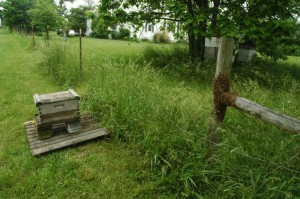
The bees in this state are about as gentle as they can be. They’ve gorged on honey prior to leaving the hive, and are merely seeking an intermediate place to settle while the scouts find a permanent location. Lucky for me, they roost on a fence post right next to the hive, the same place another swarm had chosen just yesterday (and not, say, on a branch sixty feet off the ground).
I set to putting them into a temporary hive, as I had done with Friday’s swarm.
And let me talk about the Nasonov pheremone for a brief moment. Because it means a lot to me.
When I ponder all I’ve gained in moving to the country from a house and respectably well-paid job in New York, and giving up all that goes with same — annual 401k contributions, good health insurance, paid holidays, pay! — I can now add as a compensation an intimate familiarity with the workings of the Nasonov pheremone, which is what worker bees release to orient returning forager bees back to the colony.
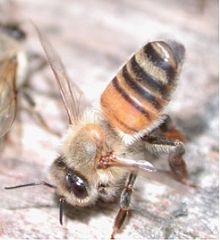
When capturing swarms, beekeepers are looking for the distinctive butt-up, fanning behavior (displaying the Nasonov gland) as an indication that they have succeeded in transporting the queen from the temporary roost to the intended hive destination. To start moving the swarm I scoop handfuls of bees into the box. One random scoop had what looked like a virgin queen but I wasn’t entirely sure. When I laid the scoop into the box, bingo! The timbre of the buzzing changed instantly and dozens of bees suddenly stationed themselves at the edges of the box and began the fanning action. My work was pretty much done at this point. I walked away and returned at dusk, and the hive was full. All I had to do was put the hive cover on.
It’s possible that our generation may lose bees altogether. I won’t lay out the case for bee extinction, but a few minutes of googling around, and you will at least be familiar with it. It occurs to me as I type this that our kids’ kids won’t know what a real drone is, but they will be all too familiar with the mechanized war-fighting snooping machines that are named after the least useful members of the bee family….
But that is some disturbing, dispiriting stuff, and as I have already said, today I’m not letting that sort of thing harsh my buzz.
Heather and the kids were at the beach all last week. While I missed them dearly and eagerly awaited their return, I will say that it is also true that I reveled in being a bachelor and having the place to myself. But bad things tend to happen on the farm when I’m on my own.
When Friday dawned, I pondered my options for the coming day. Golf? Maybe a drive to Louisville or Lexington? Or perhaps visit a distillery? Be a nice day trip to Clermont, Loretto, Bardstown…
All that evaporated the moment I walked out to the pasture, coffee mug in hand, and came upon a commotion: the entire herd clustered around and nosing at a cow down on her side. I could see from the gate she had bloated. Her left side was grotesquely distended. It’s common to describe a bloated bovine as having blown up like a balloon. This is not an exaggeration.
I tried to stand the 1500-pound cow up. By myself. Futility. I started calling neighbors for help, left a few messages, and then got the vet assistant to pick up. He told me to get a hose down her to let off some of the gas. ASAP. Two years ago I had a heifer die of bloat a couple of hours after being turned out into a fresh clover paddock. (As it turns out, that heifer was the calf of the cow in question. A major aha! re the common genetics, but a little late to be useful).
Number 19 in happier times. I always think that bit of hay looks like a cigarette hanging out the corner of her mouth. That is the kind of attitude this cow had.
So I cut off a length of my garden hose and ran out to the cow, who was lying in mud, eyes rolled back in her head. I eased the hose (as easily as one can) down her throat. Enter my neighbor Mike, a seasoned cattleman of the old school, who told me the hose I was using was too flexible. I ran back to the house and cut a section of PE pipe, and ran back to the cow. No, Mike said, too stiff. So back to the house to cut a third section of hose, satisfactory to Mike, and we worked it down together. My job was to listen for the gas to see if we had the hose in the stomach. At one point I said I was not sure, and he asked me to hold it up so he could hear. When I did, a good-sized stream of bile and foam squirted into his ear. He took it in stride, and patiently explained that it was probably a good idea to hold the end of the hose NEXT to the ear. Ever the slow learner, five minutes later I had a pint of the same stuff running down my neck.
The cow’s left side was coming down some and she was able to breathe a little easier. Her eyes were closed, no longer rolled back. The next thing was to get her stood up, but in the mud that proved to be an impossible task, even after we were joined by my brother-in-law Tom. We wrapped a chain around her neck and tried to pull her up tug-of-war style, to no avail. Then we attached the chain to the hitch of Mike’s truck. We got her sitting, tucked her legs under her, and for just a second had her on her feet. Then she toppled over on to her right side. We repeated this comic routine for another 45 minutes. I was the last to realize this was not going to work.
“Well, you could beef her.”
I hated the idea. Number 19 (her tag long since rubbed off on a T-post) was the last left alive of the first five cows I had bought to start the herd, and the first one to calve. She was a bossy old thing, probably the herd’s alpha cow, and I was kind of fond of her. But the consensus was that she was never getting up and I had to make a quick decision. Either take her for meat or call the Dead Truck.
We called a few local small processors. Not one was willing to come kill and quarter her in the pasture on such short notice. And apparently no processor is allowed (or willing) to hang and butcher halves or quarters of beeves they hadn’t killed themselves.
Another neighbor, Albert, had appeared, and Mike soon somehow managed to volunteer Albert for the job of killing and butchering the cow. Albert was less than keen at first, but he started talking it through. He said give me half an hour for lunch and if you haven’t figured anything else out, give me a call.
Albert had grown up on a farm, and had a business raising and training walking horses. Previously he had worked as a nuclear physicist for the military. We had a bit of shared bond as (over)educated farmers and outsiders, having arrived in central Kentucky from different places. He from Kansas, I from Minnesota. And it turns out he had worked in a butcher shop as a teenager. Between his skill set and my pristine copy of Basic Butchering of Livestock & Game, we could make a go of it.
So in the early afternoon Albert came and did the deed. We made idle conversation as the cow bled out, and that is never a pleasant thing to be near. Albert then chained the rear legs to the hay fork on his John Deere and hoisted the once-cow/now-carcass over to a grove of trees in front of the barn, out of the howling and at times bitter wind. Albert had asked his friend Brian, a fellow horseman, to join us, and he was strong, energetic and clever, an indispensable addition. The skinning and quartering of a 1500-pound animal is a big undertaking at any time, especially as we lacked certain power tools that would have made the job much easier. We had to take turns with a meat saw to bisect the thing. I continued to consult The Book. Dissect the bung, and tie it off with a piece of string. Each turned page had another smear of blood.
Having split the carcass, Albert drove the tractor to our back yard, where we commandeered our picnic table and an old sheet for the butchering. We worked at that from 4 til well after dark. Albert had the butchering skills, Brian and Tom, both hunters, applied their experience with deer to the larger animal, and I … well, I assisted in whatever ways I could. Mike said he had a powerful meat grinder, which was excellent news, but when we went to get it, we weren’t sure what to make of it. Someone, a cousin of Mike’s, had taken an old hand-cranked grinder, bolted it to a piece of barn timber, and attached a motor. It took us some time to assemble it and to gauge the amount of meat we could feed into it without making it grind to a halt. We soon realized that when it choked we could just manually spin the wheel, minding our fingers, to force stuck pieces of meat or fat through. My skills being on the low end of the hierarchy, I was on hamburger duty while the others separated the carcass into primal cuts and found the parts that might produce steaks.
“Do you care about the short ribs?” When I said I might want some, we had to find a way to cut them up. I remembered my circular saw, and set to cleaning the wood and cobwebs off. It spat flecks of beef all over the place, but was pretty useful in cutting up the ribs.
We had to stop when it was completely dark, and improvised ways to store the meat away from our dog and cats and whatever else might wander into the yard, attracted to the smell.
Saturday morning, while I was waiting for the others to show up, I observed the cows getting nutty: the scent of the blood got the entire herd into a crazy state. There was a lot of head butting and full-tilt sprinting across the pasture, and much bellowing. The bull, usually the mellowest of animals, was frantic. It was an awe-inspiring and slightly intimidating scene.
A little before noon Tom and Albert came back to finish the butchering. We worked pretty much nonstop through the afternoon into the evening. The first Final Four game between UConn and Florida was midway through the first half when we had finally packed both my chest freezers full and sent off a crate with Albert.
The work was hard and constant but we were all in good humor through both days. Albert said he probably would not have taken on the job if he had known what was involved, and I think we all agreed with that. I said I might be calling you again, knowing what all you can do. He said, I’ll be sure not to pick up the phone when I see your name and number.
Early Saturday afternoon I seared a big brisket on the grill and stuck it into the oven to braise. Tom threw four strip steaks onto the grill, and we broke for lunch. I guess I had been apprehensive about actually eating this meat from a mature cow, meat that we had no way to properly age. But the steaks tasted amazing, as did the brisket, which we ate as we watched the Wildcats win yet another game with a last-second Aaron Harrison shot.
And last (Sunday) night came the true test, when I served up old number 19 to the wife and children. I had fears they would resist on sentimental grounds, or would think the meat tasted funny, and I would be stuck with two chest freezers full of beef I would have to eat myself. Fears unfounded, all three of them wanted a second helping!
I could easily insert some Wendell Berry-esque reflections on the nature of community and work, and they would be appropriate. But I’ve been out here in the country for over a decade now, and I am somewhat ambivalent about Mr. Berry. Sometimes (often) I give thanks and praise for his soul and wisdom. Bless His Heart. I really do think he is the Greatest Living Kentuckian, if not in the running for Greatest Living American. But for me there are other times when it’s Goddamn Wendell Berry for getting me into this farming life. I know it’s not his fault. I’m coming to realize now that I lack many, or most, of the attributes necessary to become a good farmer, and am too scattered, too corrupted by modernity, too fond of bourbon and rock n roll and sleeping in and watching basketball all night while reading Vogue magazine. Lack of self-knowledge. That’s on me. I’m fairly sure Wendell might find me a peculiar kind of farmer if ever we met.
This weekend my farming adventure came together in a very Berry way, though, and ended well. Until the next farming catastrophe, it will be Wendell, Bless His Heart.
Number 19 was my first cow to calve. She was not crazy about me and my camera.Bloat is nasty business.
I’m kind of obsessed with Kentuckians for Strong Leadership, a faux-grassroots super-PAC of out-of-state millionaires ponying up big bucks to re-elect the odious turtle vampire zombie Mitch McConnell. That is some of their artwork up there. Pretty high quality, wouldn’t you say? In the graphic on the right there appear to be issues with color balance. Why, McConnell’s challenger Alison Grimes seems to be as dark, if not darker, than President Obama. Surely some mistake has been made!
As for the “Kentuckians” part. Well well well. Don’t see too many Kentuckians on this list. In fact, don’t see any.
Anyway, while I’m sure it cost a pretty penny, the Kentuckians for Strong Leadership web site looks to have been assembled by middle-schoolers. This particular page seems to take for granted that Harry Reid is some sort of radical liberal, and that the idea that coal makes us sick is some sort of laughable notion.
Ha ha. Reid is only talking about easily verified research — and he was only talking about air pollution. Look to West Virginia to see what coal does to our water. Kind of ironic, but not exactly funny, that the current water crisis catastrophe is caused by toxic chemicals used to make coal CLEAN (for the air, sort of).
When we talk about the process, then, we are talking, increasingly, not about “the democratic process,” or the general mechanism affording the citizens of a state a voice in its affairs, but the reverse: a mechanism seen as so specialized that access to it is correctly limited to its own professionals, to those who manage policy and those who report on it, to those who run the polls and those who quote them, to those who ask and those who answer the questions on the Sunday shows, to the media consultants, to the columnists, to the issues advisers, to those who give the off-the-record breakfasts and to those who attend them; to that handful of insiders who invent, year in and year out, the narrative of public life.
But lately, (this is pure speculation) since she has moved from the Washington DC area, Cox’s perspective appears to have broadened a bit.
In June she issued a series of tweets name-checking Wendell Berry’s “Manifesto: The Mad Farmer Liberation Front.” That’s a poem I’m pretty much obsessed with so I notice these things. “Amazing how this poem, rolling around in my mind for the past month or so, keeps becoming relevant to the news,” she wrote. More recently she has used her bully pulpit as the US politics correspondent for the Guardian to shout to the mountaintops that the West Virginia water catastrophe is a big fucking deal, certainly orders of magnitude bigger than the stories that catch the imagination of establishment journalists.
Noting that there has been a second leak at Freedom Industries, inexplicably still in business following some shady bankruptcy/temporary financing sleight-of-hand, and more of the obfuscation we’ve come to expect from West Virginia’s Department of Environmental Protection, Cox writes:
This seems like juicy stuff to me. Yet the story, as the national media sees it, is over. On Friday, MSNBC killed a segment with activist Erin Brockovich on the topic in order to devote more airtime to Chris Christie’s traffic problems.
bumped by @msnbc as they cover Christie, 300k without water in WV & all these officials do is play political games http://t.co/rDkxoj8wWa
To anyone that follows environmental news, this arc is familiar: A human-interest story with an environmental pollution angle breaks through the media chatter. Cable news outlets roll clips of distraught residents. Footage the damage unspools (with or without stomach-turning images of dead or injured wildlife). There is a news conference of dubious utility. Investigative reporters find evidence of previous infractions of safety and environmental regulations. Politicians declare the need for hearings and more strict enforcement. Volunteers show up to help. Sometimes there’s a concert.
Then we move on. We move on despite the fact that the chemical leak was, in some ways, an improvement on the status quo for West Virginians: at least the residents knew there were questions about the water piped into their homes. Most of the time, most West Virginians simply live in the toxic aftermath of the daily release of not-quite-as-verifiably deadly chemicals. The mix of air, water, and soil pollution that is a matter of course in coal mining counties means that children born in those areas have a 26% higher risk of developing birth defects than those born in non-coal-mining counties. That’s not from drinking water that’s been declared contaminated, that’s from drinking water, breathing air, and playing on ground they’ve been told is safe.
The underlying crisis behind most environmental tragedies is the part of the story that we rarely hear about. Our attention is shifting away from chemical spill, as it has from mine collapses and explosions, from oil spills, and, often, from natural disasters as well.
Cox goes on to explore “a distressingly simple pattern of cause and effect”:
… for 200 years, and most particularly during the last two decades, the coal industry (and the energy lobby in general) has been as much, if not more, effective and industrious in its influence on politicians than it has been in generating electricity.
Our country has grown a vast and complex regulatory and financial support system for cheap, dirty energy: tax breaks, loopholes and the like. Researchers estimate that if Americans has to pay the real cost for each kilowatt-hour, factoring in hidden costs to communities’ health, economy, ecology, we would pay three times as much than we do today. The energy lobby’s approach to influence peddling, on the other hand, has [the?] systematic elegance of a see-saw: They put money into politicians’ pockets, and they get legislative favors back. Indeed, it has been 38 years since Congress passed any law that had a substantive impact on the use of toxic chemicals. To put that in context: in 1975, we were still using asbestos in our walls, you could smoke on airplanes and food packagers did not have to report or monitor pesticide residue levels on fresh produce.
Cox also mentions the stunning news (to anyone paying attention at the time) that the New York Times dismantled its environmental reporting desk last year, leaving “approximately 15 dedicated environmental reporters among the nation’s top five papers.” I do wish she had acknowledged the indefatigable, jaw-droppingly excellent work done by regional reporters. (If the Charleston Gazette staff does not win a Pulitzer Prize for its coverage of the Freedom Industries debacle, I will know the fix is in).
I was going to conclude this post by wishing Ms. Grimes well in her campaign against the McConnell machine, but then made a quick visit to her campaign web site and my shoulders slumped a little bit to read her “energy” position statement featuring boilerplate that could have been borrowed from Mitch himself.
I strongly oppose President Obama’s attack on Kentucky’s energy industry. This Administration has taken direct aim at Kentucky’s coal industry, crippling our state’s largest source of domestic energy and threatening thousands of jobs. Washington Democrats and Republicans need to be realistic about what powers our nation and recognize that developing Kentucky’s supplies of coal is crucial.
War on Coal. Please. Do not start with that. If Obama were fighting a war on coal, maybe he would have offered a comment on the Charleston debacle. He released disaster money for the Charleston, area, but otherwise … crickets.
From the EPA, that evil all-powerful slayer of the angelic job creators of the coal industry, pretty much crickets as well. The White House and the EPA are integral parts of the “tableau of abdication” Jedidiah Purdy noted in the New Yorker a few weeks back.
As are politicians from states controlled (there is no other word) by coal. One day there will be a Kentucky politician who acknowledges the real costs and depredations of the business of coal, which extracts the coal out of the ground, and the profits out of the state. But this ain’t that day. Even with the West Virginia catastrophe in the headlines, our state has no politicians to take the side of its mountains, streams and people against a brutally destructive business, a business that is, by any objective standards, “a loser economically, environmentally, and in terms of public health.”