The thing about farming is this. You never really know if you’re doing it right.
I found both of my donkeys dead in the trees yesterday. My guess is that they grazed something poisonous, most likely poison hemlock, which is everywhere in the early spring.
After finding them, I took to Googling around on the subject of poisonous plants and livestock. And yeah, maybe I should have been alert to the possibility that my donkeys or cows would try some new forage, especially as the grass has not really taken off yet.
I might have realized that the donkeys always tend to eat last. They get shoved out of the prime grazing areas and kept away from the round bales by the cows. Still, they looked in great health, even after a hard winter.
Being a good farmer takes time. And lots of observation. And the conclusions he draws from those observations can be useful, or they can be dead ends. They can involve seeing something insignificant as important.
When donkeys up and die, or a cow dies, or has a stillborn calf, or when I find a dead beehive filled with honey, I have to interpret some maddeningly ambiguous signs. I might take action based on these signs, but are they the correct actions? Am I grazing the cows efficiently? I judge by how the pasture looks the following year. But is that nice clover growth a result of my clever grazing management, or just because we had an exceptionally wet spring? It’ll be years before I really know, and then will I know what I know any more than I do now?
A line from a senior year contemporary American poetry seminar has stuck with me: experience prepares you for what will never happen again. That used to haunt me. Now, not so much.
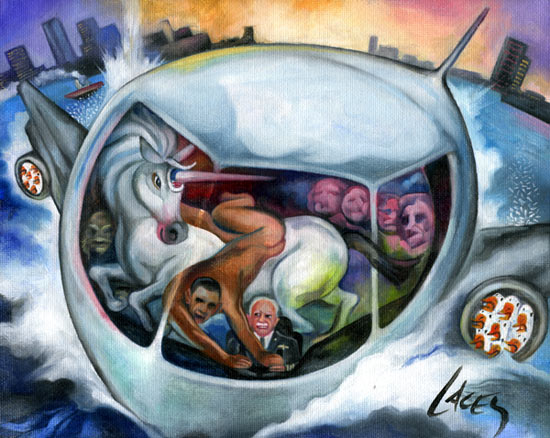
Unicorn-bestriding super-prez saves Captain Sulley AND passes historic health legislation!
I’m still waiting for those public forums on C-SPAN that Obama promised when campaigning. You know, where all parties come to the table, instead of legislation based on a series of shady back-room deals with insurance and pharmaceutical execs and lobbyists.
[Y]eah, I think the hospital industry’s got a deal here. There really were only two deals, meaning quid pro quo handshake deals on both sides, one with the hospitals and the other with the drug industry. And I think what you’re interested in is that in the background of these deals was the presumption, shared on behalf of the lobbyists on the one side and the White House on the other, that the public option was not going to be in the final product.
It was back in 1971 and President Nixon was concerned that he would once again have to face a Kennedy in the next year’s election — in this case a Kennedy with a proposal to extend health care to all Americans. Feeling the need to offer an alternative, Nixon asked Congress to require for the first time that all companies provide a health plan for their employees, with federal subsidies for low-income workers. Nixon was particularly intrigued by a new idea called health maintenance organizations, which held the promise of providing high-quality care at lower prices by relying on salaried physicians to manage and coordinate patient care.
At first, Kennedy rejected Nixon’s proposal as nothing more than a bonanza for the insurance industry that would create a two-class system of health care in America. But after Nixon won reelection, Kennedy began a series of secret negotiations with the White House that almost led to a public agreement. In the end, Nixon backed out after receiving pressure from small-business owners and the American Medical Association. And Kennedy himself decided to back off after receiving heavy pressure from labor leaders, who urged him to hold out for a single-payer system once Democrats recaptured the White House in the wake of the Watergate scandal.
But it should tell you how far the country has moved to the right that the various proposals put forward by a Democratic president and Congress bear an eerie resemblance to the deal cooked up between Kennedy and Nixon, while Nixon’s political heirs vilify it as nothing less than a socialist plot.
Yes, we’ve come a long way, in an icky direction. But the Republicans’ appalling behavior is really the sputtering of the powerless. The GOP and its elected functionaries are simply obstructing a deal they wish they had struck. As for their shock troops, the dissonance is simply too much and they are bellying up to the table and scarfing down vast quantities of their peculiar comfort food: paranoid ideas of a super-powerful government and, that old standby, race-based vilification. They are burrowing deeper into their crazy places than I had thought possible.
But the lunacy of certain powerless factions, while capable of generating horrific acts, is a sideshow.
The main event is this: the party in power made a bargain with industries with a proven record of doing actual harm to the health and well-being of the electorate. The president spoke in favor of a public option while in private reassuring insurance and pharma that it ain’t gonna happen on his watch. Really. He did. There is no electoral justification for this strategy, as the Republicans were going to oppose anything he put forward anyway.
Obama is indeed a walking Rorschach test, but I would humbly submit that he is not the Hitler/Stalin/Chavez/Satan composite of the teabaggers’ fevered imaginings. Just as important, some of his partisans need to get a clue. He falls waaaaaaayyy short of being a heroic champion of progressive values.
This bill, if it ever gets enacted, four years down the line, might be a step in the right direction. Or, even its supporters must accept, it might not. It’s a mess. As Michael Moore points out, some will benefit hugely, but, as Donna Smith, a blogger on his site, also notes, in the near term, people will keep dying by the thousands for the crime of not being able to pay for health care. “The dead SiCKOs would still die; the bankrupt and broken would still break; and the ill would still suffer.” In large part this is because the President and Congress suddenly value thrift with the national budget (except, uh, it need hardly be said, here) and the patronage of cronies over their voters’ lives.
The Democrats can count their blessings that they exist at the same time as the current version of the Republican party, which has pretty much gone completely crazy. In the presence of such batshit opposition, they get a pass for being merely appalling.
With the groundswell of support and good will they had in the 2008 elections, the sky was the limit, but they took single payer off the table immediately, and cut a deal eliminating any kind of public option (while singing its praises, and fretting that they didn’t have the votes). We’re still going to have a single payer system in this country. We could have done it this year, but it will have to wait until millions more are overwhelmed by the costs of health care, which this legislation does nothing to contain.
A great summer song, from Australia’s immortal Go-Betweens, that I will forever associate with the recession summer of 1989, when Dave Campbell and I were both Laury Girls, i.e. temps with the Laury Girls Agency.
Every day for at least a month we would bike up to Central Park from Brooklyn, avail ourselves of the frosty Budweisers from the illicit vendors, throw a frisbee, and listen to the Go-Betweens on my roommate’s Yellow Sony Sports boom box.
All day. Except twice a day one of us would walk to a phone box on Central Park West and call the office, asking about work and hoping to be told there wasn’t any.
Well that was then. This is Now, and Moveon is threatening to “primary” progressives like Kucinich who haven’t changed their minds and continue to insist on a robust public option.
I said “I find it odd that when it’s down to Joe Lieberman’s one vote, everybody shrugs their shoulders and says ‘oh well, we just have to write the bill Joe wants, because what can you do, one vote.’ And when it’s Dennis Kucinich’s one vote, which represents what 80% of the American people want, it’s “lets crush Dennis Kucinich so we can give Joe Lieberman everything he wants.” Somehow the argument keeps switching so that the corrupt deal that the White House negotiated with the pharmaceutical companies gets passed no matter what.”
We are all familiar with the president’s remarkable turnabout on his signature issue. We can speculate, with varying degrees of cynicism, about why he changed his mind, but the nation’s needs have not changed, and the legislation currently being considered does not begin to meet them.
Dr. Marcia Angell, editor emeritus of the New England Journal of Medicine, reminded us of the big picture on Bill Moyers Journal last week:
BILL MOYERS: So, has President Obama been fighting as hard as you wished?
MARCIA ANGELL: Fighting for the wrong things and too little, too late. He gave away the store at the very beginning by compromising. Not just compromising, but caving in to the commercial insurance industry and the pharmaceutical industry. And then he stood back for months while the thing just fell apart. Now he’s fighting, but he’s fighting for something that shouldn’t pass. Won’t pass and shouldn’t pass.
What this bill does is not only permit the commercial insurance industry to remain in place, but it actually expands and cements their position as the lynchpin of health care reform. And these companies they profit by denying health care, not providing health care. And they will be able to charge whatever they like. So if they’re regulated in some way and it cuts into their profits, all they have to do is just raise their premiums. And they’ll do that.
Not only does it keep them in place, but it pours about $500 billion of public money into these companies over 10 years. And it mandates that people buy these companies’ products for whatever they charge. Now that’s a recipe for the growth in health care costs, not only to continue, but to skyrocket, to grow even faster.
This is madness. Expanding Medicare to cover everyone, as I have written earlier, would actually save everyone money immediately, and the country as a whole. Consider that the most expensive consumers of health care–the elderly–are already in the system. Adding younger, healthier people to Medicare would cost incrementally much less. That’s why the Canadians spend about 9 percent of their GDP on healthcare, while covering every Canadian, while we spend nearly twice as much and leave 47 million of our citizens uninsured and unable to visit a doctor. How could it be cheaper to add everyone to Medicare? Expanding Medicare to cover everyone would probably cost somewhere between $800 billion and $1 trillion a year. That sounds like a lot of money, until you consider that we already spend $100 billion a year to care for veterans through the Veterans Administration, and $400 billion a year to care for the poor through Medicaid. We also spend $300 billion a year subsidizing hospitals that have to provide “free” charity care to the poor who don’t qualify for Medicaid, too. Since all those people would be covered by Medicare under Medicare-for-All, that’s $800 billion a year in current expenditures saved right there.
I will just pass on Hamsher’s urging to take whatever action you can:
I still don’t know if they can pass this monstrosity of a bill. But if progressives stand down and do nothing while corporate America runs roughshod our institutions and our representatives, no member of Congress will ever have the political courage to stand up against corporate power again.
Call members of Congress who said they would vote against any bill that doesn’t have a public option. Tell them to keep their promise.
Update: Kucinich caved. “[A]las, the will of the people and the decisions made by those who are constantly trolling for corporate campaign contributions are seldom aligned.”
It’s a complex, nuanced piece, and well worth reading in its entirety, but a point Ackerman makes in his conclusion screams out for comment.
This is not an argument about whether Obama “pushed hard enough” on this or that, or whether Harry Reid sold out such-and-such. The obsession with this kind of short-term thinking is the whole reason why we’re in this mess. It’s quite possible Obama couldn’t have gotten elected if he’d proposed anything more ambitious than the “Demo-plan.” And once in office he may not have been able to get his Demo-plan passed without dropping the more liberal features.
But all of that is beside the point. Whether or not a better health reform plan could have passed at this precise moment is a secondary issue. The larger question is what this bill tells us about this precise moment. Obama came into office with every whim of history leaning in his direction: a discredited Republican predecessor, a crisis of deregulated finance that reached a crescendo literally weeks before the election (what luck!); the largest Democratic majorities in decades (in a sense, even larger than the 1965 majorities; not counting southerners, the Democrats had 47 Senate seats in 2009, versus 40 in 1965). Such a clear shot will not return for decades.
And the result: The Democrats shot their historical wad on health care by re-introducing Bob Dole’s bill from 1994 and justifying it as a free-market solution. How is that a “huge progressive victory”?
Wait? Uh, what? Bob Dole’s bill from 1994? Ackerman just sort of snuck that in there. But take a look at this “executive memorandum” from the Heritage Foundation, “Dole’s Health Care Compromise: A Prudent Foundation for Reform”:
[Dole’s] bill requires insurers to renew policies and prohibits pre-existing condition limitations in new policies, while protecting insurers by allowing reasonable waiting periods. It also limits premium variations to differences based on age, family size, geogra- phy, and other risk factors, but not health condition. Further, the bill blocks states from mandating insurers to include costly benefits that buyers do not want. It introduces malpractice reforms to reduce legal costs, and reforms the antitrust rules to make it easier for groups of physicians or other providers to do business.
The bill also encourages the creation of purchasing groups, including non-employer associations, to bargain for good insurance rates. But wisely, it does not mandate health alliances, or force- employers to pick plans for their employees. Thus, Americans could join health insurance purchasing associations based on, say, a church, a union or a farm bureau, not just an employer-sponsored pool.
Mmm. Yes. That does look vaguely familiar. Wow. Obama sweeps into power with “every whim of history leaning in his direction,” and an unprecedented opportunity to push for real reform, and we get… Bob Dole.
And if you, like me, are sick and tired of hearing “it’s a start” and “it’s better than doing nothing,” there’s this:
But it gets worse. The decentralized private payment system will inevitably start crowding out the public insurance we already have, especially Medicare. With continued double-digit medical inflation, the slow-motion dismantling of Medicare isn’t a possibility, it seems like an eventual certainty. (Just look at the current deficit hysteria, which is now being propitiated by the White House and its independent commission.) We are on a moving train going in the wrong direction; instead of turning the train around, this bill tries to solve the problem by having us all run towards the caboose.
Barring some sort of divine intervention, whatever version of health care reform that passes will be an unmitigated disaster for America. I didn’t vote for Obama (or, I should not have to add, McCain), and wasn’t expecting much, but this tops my most pessimistic imaginings.
Been in the garden digging. Digging like Kevin Bacon. Have you ever seen Stir of Echoes, where Bacon’s character, post-hypnosis, starts tearing up his garden and even basement? “I’m supposed to dig,” is all he can say, except when he mutters, “Tools.”
That’s how I feel this time of year. Dig. Dirt. Tools.
And it puts me in a good mood, a good enough mood to post a link to a story that is not along my customary lines of how we’re being boiled alive like a potful of oblivious frogs by a predatory militarist corporatist state. No, reader, this story is a happy one, or at least it features cause for optimism. It’s about one of the best simple ideas I’ve heard in a while: turning unused (or, in this case, underused) mall space into a greenhouse/farm stand.
Shopping malls, those bastions of American consumerism, have not been immune to the recent economic downturn. In a recent piece by our own Greg Lindsay, we looked at the impending decline of the mall, which is part of the “single-use environment” category of real estate development that will slowly disappear over the next thirty years, according to one developer. But what will replace these environments, and more importantly, what will happen to the massive malls of today?
One possible solution can be seen in Cleveland’s Galleria mall. The mall lost many of its retail shops over the past few years, leaving gaping holes in the greenhouse-like space. So employees of the Galleria came up with the idea for the Gardens Under Glass project, a so-called urban ecovillage inside the mall that features carts of fruits and vegetables grown on-site. The project was recently given a $30,000 start-up grant from Cleveland’s Civic Innovation Lab.
We can see it now: the malls of today turned into the suburban (and urban) farming powerhouses of tomorrow. And while we’re at it, why not turn entire economically depressed cities into agricultural centers as well? It’s already happening in Detroit, where entrepreneurs are turning vacant lots into factory-side farms. And if Cleveland’s mall farm works out, maybe New Jersey can become the next big agricultural innovator–the state has the most malls per square mile in the country.
Emusic now has the Pogues catalog, which is cause for celebration and for me cause for a rather vivid flashback to 1985, the year of Rum, sodomy and the lash.
I found the wiki on the year fascinating and foreign, yet strangely familiar. (And yes, the original Back to the Future was based in that year.)
Herewith, the brilliant Pogues classic, “A pair of brown eyes,” and an entertaining, not particularly linear video by Alex Cox (police state! Thatcher!), along with a few other carefully culled selections from that year. Presented without further comment.
The Obama regime has, for me, been an even bigger nightmare than the preceding eight years. The Democrats first swept into power in the 2006 midterms, and cemented their stranglehold on Congress and the Executive branch two years later. They promised change, and transparency, and delivered neither.
Whatever protestations Obama and his party make about ideals and values, the Health Care Reform debacle shows the real lay of the land. If you thought the Democrats would take decisive action to actually represent the interests of the voters against the predations of corporations, by now you should be pretty well disabused of any such notions.
For the White House and most of Congressional Democrats, the idea behind their version of “reform” is simple. Cut a deal with the insurance and pharmaceutical industries in exchange for … money, and throw a few cosmetic improvements into the package that will in no way flatten the ever ascending arc of the profit margins of the insurers and pharmaceutical companies.
It’s really that simple. The Republicans, for their part, hate the Deal not because it violates their principles, but because they want to be the party cutting it.
Only Dennis Kucinich has consistently spoken up for what is the only rational (and ultimately much cheaper) solution to what is a crisis for many, if not most, Americans: single payer, medicare for all. Take five minutes and listen to this man.
For further reading, spend some time at firedoglake, where Jane Hamsher and Jon Walker and others have been providing enlightening accounts of the deceptions and delusions behind this disastrous piece of legislation. Here is a list of health care-tagged posts.
This has been a preoccupation of mine lately, wondering how to express my admiration of SOME of the principles of the Ron Pauls of the world. I’ve half articulated the thought that “Yes, he is totally batshit crazy on some issues, but exactly right on others” and I was trying to find a way to describe mainstream Dems and Republicans as being just as crazy as—if not more— crazy than Paul.
Just consider who is supported and embraced by those who slap the “crazy” label on the forehead of every perceived dissident. Hillary Clinton — the ultimate embodiment of Democratic Party Seriousness and Sanity — supported the invasion of Iraq by warning of scary weapons and Al Qaeda ties that did not exist (“Saddam Hussein has worked to rebuild his chemical and biological weapons stock, his missile delivery capability, and his nuclear program. He has also given aid, comfort, and sanctuary to terrorists, including Al Qaeda members”), and she spent her campaign beating her chest and doing things like threatening to “totally obliterate” Iran. While in office, Barack Obama has endorsed putting people in cages with no charges, assassinating American citizens with no due process, eavesdropping on Americans en masse with little oversight, increasing military spending beyond its shockingly inflated levels while searching for ways to cut Medicaid and Social Security, and blocking judicial review of presidential felonies and war crimes on the ground that those criminal acts constitute vital “state secrets” and must be protected. Most Serious, Sane Democrats have supported all of that insanity.
Meanwhile, the GOP establishment from top to bottom spent a decade cheering on torture, disappearances, abductions, unprovoked wars, chronic presidential lawbreaking and truly sickMcCarthyite witch hunts. Both of the Sane Parties conspired to transfer, with little accountability, massive amounts of public wealth to the very Wall Street firms which virtually destroyed the entire world economy, while standing by and doing very little about tragic levels of joblessness or the future risk of Wall-Street-caused financial crises; kept us waging war for a full decade in multiple countries (while threatening others) even as we near the precipice of bankruptcy, the hallmarks of under-developed nation status and the disappearance of the social safety net; and are so captive to the corporate interests which own the Government that they viciously compete with one another over who can be a more loyal servant to those interests.
While all of that is happening, those whom all Serious, Sane people agree are Crazy — people like Dennis Kucinich and Ron Paul and Alan Grayson — vehemently oppose most if not all of that and try to find ways to expand the realm of legitimate debate and political alliances beyond the suffocating stranglehold of those responsible. So who exactly is Crazy?